The Macedonian Tendency: Alexander The Great
Showing posts with label Alexander The Great. Show all posts

Sunday, August 21, 2011

Thomas Brey Is A Vampire and Supporter of Greek Racism!

By David Edenden

Thomas Brey
(He's not pretty)
This article below by Thomas Brey, who  heads the Balkan office of the German DPA news agency, is an example of the uphill battle Macedonians have in their struggle against Greek racism. He is "soooo" concerned about Greek sensibilities but ignores Greece's attempt to  wipe its ethnic Macedonian minority off the map.


I doubt that he will every write about the Greek priest's conspiracy to burn down the proposed Macedonian language radio station in Greece. Remember, Greece's minority rights values are, by definition EU and Nato values and naturally German values. Even at a time when Greece has made a mess of Europe's (and German's) finances, our friend Thomas still finds it in his heart to weep for Greece's racist ideology.


Nick, next time this fascist sets foot in the Republic of Macedonia waterboard him ... (remember waterboarding ins not torture)!

Skopje-Athens dispute: Who "owns" Alexander the Great? -
Monsters and Critic, By Thomas Brey Aug 21, 2011, 
Greece has been insisting on a change of name for the Balkan state. Internationally, Skopje has thus been acting under the bulky name of 'Former Yugoslav Republic of Macedonia.'
Every attentive student knows from history class that Alexander the Great belongs to Greece just like the Acropolis in Athens.
And still Greek history professor Basi Gounaris in Thessaloniki says, 'This conflict is never going to be solved, I'll bet my money on that.'
'What Skopje is doing is nationalism in the style of the 19th century,' he adds, condemning the recent events.
And in Greece, no political party would take the risk of solving the problem - history is the only thing 'that keeps the Greek population together,' the professor adds.
'Antique history is of such tremendous value for us that we cannot accept any compromise.'

Monday, April 05, 2010

How Vile Is Christopher Hitchens? ... Let Me Count The Ways.

By David Edenden

I can't read minds, but I doubt that Christopher Hitchens gives a damn about the Armenian Genocide, notwithstanding the article below. 

Turkey denies history—all the more reason for the rest of the world to tell the truth about the Armenian genocide. - By Christopher Hitchens - Slate Magazine:

"the later erasure of all traces of Armenian life, from the destruction of their churches and libraries and institutes to the crude altering of official Turkish maps and schoolbooks to deny that there had ever been an Armenia in the first place."

 It is merely a sort of reparation payment to his Greek Cypriot wife for abandoning her in England (along with his children) while he takes up with"true love" in the US.

Inaddition to Cyprus, the Elgin Marbles, comrade Hitchens has found time to applaud the cultural genocide the Macedonia people in Greece in their struggle to maintain a semblance of their culture. Along with Greece's campaign to export that genocide to the people of the Republic of Macedonia. Here he is condemning George W. Bush for doing the right thing.

"The unmistakable Greekness of the trove is part of the reason that the Greek government is so upset at President Bush's recent decision to recognize former Yugoslav "Macedonia" under its assumed name."


Apparently it was only recently that Hichens discovered that his grandmother was Jewish, a fact that she hid from her own children. It is still not enough for him to summon one ounce sympathy for those Macedonians in Greece who hide their ethnicity from their own children. 1, 2, 3, 4, 5

Anyway ... to much time spent on this vile excuse for a human being. 

Saturday, July 19, 2008

A Long From Home ... Macedonians Return

Alexander’s ‘descendants’ boost Macedonian identity
FT.com / World

By Neil MacDonald

Published: July 18 2008

On Saturday, an unusual delegation from the Himalayan foothills bids a quiet farewell to the Republic of Macedonia.

Prince Ghazanfar Ali Khan, his wife Princess Rani Atiqa and their entourage claim descent from Alexander the Great’s conquering army, which reached their Hunza tribal homeland in northern Pakistan 23 centuries ago.

The fair-skinned, blue-eyed Hunza people, whose own accounts trace their descent to Alexander’s march-weary troops, are renowned for their longevity and their high literacy rate.

Officials initially rolled out the red carpet for the septuagenarian prince and his entourage, who have toured cultural and historical sites since arriving at Skopje’s Alexander the Great airport on July 11. Nikola Gruevski, prime minister, met the delegation, while a Macedonian Orthodox archbishop blessed it.

Hunza folklore gave a shot in the arm to the ex-Yugoslav country of 2m – still embroiled, 18 years after independence, in a frustrating “name dispute” with Greece, whose northern province is also called Macedonia.

Greece has made sure Macedonia cannot join Nato without a compromise name change. The latest round of United Nations-led talks in New York produced no breakthrough.

Mr Gruevski, who won a landslide re-election victory in June, has raised the ante by this week demanding recognition for a Macedonian (Slav) ethnic minority in officially homogeneous Greece.

But Mr Gruevski’s critics have dismissed the Hunza visit as shallow populism and after ridicule in local newspapers, the youth and sport agency cancelled the princely couple’s planned appearance in Skopje’s main square last night.

The visit’s main organiser was Marina Dojcinovska, a Skopje-based travel journalist who made a film about the far-flung tribe of “Macedonians” in 2005.

“This is a very special occasion for all Macedonians,” Ms Dojcinovska said.

In fact, citizens proved divided about how literally to take their ancient origins. Their Macedonian language is closest to Bulgarian and other South Slavic tongues – pointing to roots in the tribal migrations about a millennium after Alexander.

Ana Petruseva, country director for the Balkan Investigative Reporting Network, said of the Hunza visit: “Everyone who’s a bit more educated is laughing at this.”

The Hunza of today, who are mostly Muslim, had not heard of modern Macedonia until 12 years ago, when an expatriate Macedonian linguistics professor drew their attention to it.

Ilija Casule, an associate professor at Australia’s Macquarie University, said he recognised common grammar and terms for body parts between the Hunza people’s Burushaski and Indo-European languages.

But there are plenty who question just how robust the links are. Most linguists classify Burushaski as an “isolate” unrelated to other languages. DNA research has also debunked claims of genetic links between Macedonians and the Hunza.

“Macedonia’s doing what other European countries did in the 19th century . . . elevating folk tales to official history,” said Sam Vaknin, an Israeli economic adviser in Skopje. “This belated adolescence has been exacerbated by Greek insecurities bordering on sadism.”

Greece plays the same game, funding cultural centres and schools for the Kalash, another set of Alexander claimants in Pakistan and Afghanistan. In the 1930s, scientists in Nazi Germany also combed the Himalayas in search of lost Aryan cousins.

Athens accuses Josip Broz Tito, the Yugoslav communist leader after the second world war, of “inventing” Macedonian ethnicity in the hopes of grabbing a piece of the Aegean coast.

Yet Skopje’s popular identification with Alexander did not blossom until after the 1990s Yugoslav break-up, Macedonians argue.

Sensing threats on all sides, Macedonian patriots have become more stubborn on identity, calling themselves “Alexander’s descendants” even though the ancient conqueror personally had no known children.

Aleksandar Dimiskovski, a business consultant in Skopje, says: “The [Hunza] visit provides affirmation of our ties to the former Macedonia of Alexander the Great. Approval from these people confirms that the legacy of ancient Macedonia belongs to the Republic of Macedonia, not just to Greece.”

That is a view that remains very much in contention.

Bulgaria refuses to recognise a separate Macedonian language. Serbia’s church keeps Macedonians out of the worldwide Orthodox communion. And an ethnic Albanian minority of roughly 25 per cent challenges the young state’s internal stability.

Monday, July 14, 2008

At Least One Frenchman Supports Macedonians

A Frenchman the biggest Macedonian Patriot?
MINA
A Frenchman the biggest Macedonian Patriot?


You better believe it. Robin Poupel continues to amaze Macedonians, at the same time drive the Greeks crazy.

We all met Robin when he wore red shirt with the Macedonian Sun in Athens, something not too many would dare to do

His Macedonian Shirt earned him a lengthy search by Greek Security, and no food or beverage while on Olympic Airways. Greek Airline refused to give him water & food...because of a Macedonian shirt!?

Back to Robyn Poupel. The man is on a mission. Everywhere he goes (China, California, Greece....) the Frenchman wears shirts with famous Macedonian symbols (the Sun, Lion.. of course, underneath the symbol says "Macedonia").

Who is Robyn Poupel? He is a recent graduate of the American College in Paris, with degree in Historical Sciences and International Politics. Has written numerous essays on Macedonia, Greece and International Politics.

He visited Macedonia 3 years ago, for the first time and since than has been very interested in Macedonian History and Culture. Robin posts images on his Facebook page about his trips, everywhere wearing the recognizable Macedonian shirts. Recently was also present at a World Affair, again wearing the Macedonian colors.

Robin Poupel, among many things calls on Greece to stop their lies because, as he says there were thousands of facts that Alexander the Great was not Greek, rather Macedonian. He continues to say that Greece has absolute hatred towards Macedonia and its Macedonian minority within Greek borders, and this will not change. Robin stresses on numerous places that Ancient Macedonians had nothing to do with Ancient Greeks, had different language and culture.

He has also applauded the recent release of Boskovski saying "justice has been served", at the same time asking for the release of Johan Tarculovski.

On his Facebook page, two maps can be found. Both of Macedonia. One in its present borders, the other in its pre-1913 borders including Pirin and Aegean Macedonia.

Wednesday, July 02, 2008

Colin Farrel's Alexander - Macedonians and the Irish vs Greeks and the English!


By David Edenden,

This is an old story from our friend Fiachra about Colin Farrell's Alexander. I saw the movie. Not much of a story, just enough to make Macedonians and Greeks look foolish.

Wouldn't be proper to mention the role of US/EU in this comedy. Wouldn't be prudent!. People are watching! Mum's the word.

Patriot games

Which people are the true descendants of the greatest military
commander in history? Fiachra Gibbons reports on how Oliver Stone's
epic Alexander is reigniting an ancient, bitter feud.

Friday November 19, 2004
The Guardian, Fiachra Gibbons


The first western imperialist ... Colin Farrell as Alexander

"We will come and kill you in your beds, cut your throats, and wipe
you from the face of the earth ... if Alexander the Great were alive
today he would grind you gypsy dogs into the dust, dig your dead from
their graves and silence forever your filthy language that insults his
name ..."

Internet chatrooms have never been the most decorous of forums but
even in the free-for-all that is cyberspace, those dedicated to
discussing Oliver Stone's new film, Alexander, are a case apart.

Since the combative director of JFK chose to make his first foray into
historical epics with a biopic of the most fought-over figure of the
ancient world, rivers of blood have been spilt - figuratively at least
- in a propaganda battle between Greek and Macedonian nationalists
over who has the right to claim the all-conquering hero as their own.

This very modern ethnic turf war is being fought with tortuously
argued historical blogs about which Macedonia Alexander conquered the
known world for - a tiny new Balkan republic that has only recently
come to see itself as the keeper of his flame, or a province that was
officially known as "Northern Greece" until the former Yugoslav
republic of Macedonia declared itself independent and bagged the name.

But the real blood and guts of the battle, the part Alexander would
have so enjoyed, is in the chatrooms, where fanatical foot- soldiers
taunt each other with blood-curdling threats heavy with echoes of the
short but brutish Balkan wars that carved up ancient land between
Greece, Serbia and Bulgaria almost a century ago.

Stone has remained uncharacteristically silent, preferring to wrestle
on set with war elephants and his leading man, Colin Farrell. Even for
such a seasoned controversialist, this is a scrap to stand back from.

For the struggle over who have the right to call themselves
descendents of the greatest military commander in history, and the
first real western imperialist, is neither pretty nor edifying. In the
early 1990s, Greece nearly invaded the newborn Republic of Macedonia
for "stealing" Alexander's symbol, the Star of Vergina, for its flag,
as well as the White Tower in the Greek Macedonian capital of
Thessaloniki for its banknotes, something the millions of ordinary
Greeks who took to the streets saw as "blatant acts of aggression".

The flag and the banknotes were hastily withdrawn, but Greek pride was
far from restored. To the horror of its European partners, Athens
briefly contemplated carving up its defenceless northern neighbour
with the Serbian dictator Slobodan Milosevic. In the end, Greece
stepped back, choosing instead to blockade the tiny republic of barely
two million people in an attempt to strangle it at birth. Since then
millions have been spent on a war of attrition to claim the name - and
Alexander - back.

You cannot walk more than a few hundred metres in any town in northern
Greece without tripping over a new statue, bust or monument to
Alexander, who extended the Hellenic world as far as India in the
fourth century BC with such slaughter that even today in Iran and
central Asia his name is used to scare unruly children. You will find
the most pointed statue of all at the border with Macedonia at Niki -
named after the Greek god of victory - where a giant Alexander angrily
brandishes a javelin at the upstart state across the frontier.

All over Greek Macedonia, streets, schools and airports have been
hastily renamed, while archaeologists, having all but ignored ancient
Macedonia until relatively recently, are digging furiously for its
traces. The spectacular tomb of Alexander's father, Phillip, at
Vergina near Thessaloniki, and the city's revamped museum, hammer home
the kingdom's Greekness.

Still, passions had cooled somewhat after an unhappy compromise over
the name that burdened Skopje with the cumbersome temporary moniker of
the Former Yugoslav Republic of Macedonia, or "Fyrom" for short. Greek
investment also began to build bridges - until Stone and his army of
Hollywood stars appeared on the horizon to put nationalists on both
sides back on a hair-trigger.

It is into this fraught and febrile atmosphere that George W Bush has
now wandered. With the world waiting and wondering where the president
will start the next war, Bush chose as his first major foreign-policy
decision of his second term to recognise Fyrom by its "proper" name as
the Republic of Macedonia, prompting paroxysms of Greeks anger across
the globe and Athens to vow to block Macedonia's entry into the EU and
Nato.

Even before Bush's intervention, the very mention of the M-word in
Greek Macedonia risked a stern lecture on how it has been Greek since
antiquity. I nearly lost an ear to a particularly patriotic barber in
Thessaloniki last month when I mentioned that I had just arrived from
the "other Macedonia".

Those people are not Macedonian, he raged. "That is a Slav lie. We are
the real Macedonians. They are prostitutes and Gypsies and worse than
Albanians," he declared. His family, it turned out, were recent Greek
immigrants from Georgia who, he claimed, went "east with Alexander".
He liked to take his son on Sundays to the massive equestrian statue
of Alexander on the city's seafront promenade, where Greek
right-wingers gathered after Bush's bombshell to burn American and
Macedonian flags. "I tell him to be proud of his ancestors and how
lucky he is to have returned to the land of his forefathers."

But ask anyone four hours north in Skopje what Alexander was and they
will smile sheepishly and say, "Macedonian, of course!" And when
pressed about the obvious absurdity of a country that has a majority
Slavic population claiming a man who was born nearly 1,000 years
before the first Slav appeared in Macedonia, they answer, "Well, he
was certainly not Greek."

If the Macedonians were Greek, why did Alexander have to address his
troops in both Greek and ancient Macedonian, they argue. And every dog
can quote the Athenian orator Demosthenes' famous condemnation of
Alexander's father Philip as "not only no Greek, nor related to the
Greeks, but not even a barbarian from any place that can be named with
honour, but a pestilent knave from Macedonia, whence it was never yet
possible to buy a decent slave."

"No one is saying that Alexander spoke modern Macedonian, that is
ridiculous, but who is to say that there isn't something of him still
floating around in the genome," says Vojislav Sarakinski, a lecturer
in ancient history at the city's main Cyril and Methodius university.
It is easy to ridicule all this as archetypical Balkan lunacy until
you realise how much of the emotional heat of the dispute stems from
the insecurity of both countries about their borders, fears fully
justified by the region's recent history.

Stone has been well aware of these sensitivities from the start,
though initial Greek outrage at his film focused on Alexander's
omnivorous sexuality, in particular his fondness for eunuchs. His
film, he insists, is purely about the historical "man god", and so has
made no secret of showing Alexander's love for his friend Hephaestion.
There is, however, none of the lurid decadence promised from Baz
Luhrmann's planned film about Alexander, if it ever gets off the
blocks.

Evangelos Venizelos, the formidable former Greek culture minister and
a Macedonian, attempted to get Stone onside early on, offering him
Greek locations and the use of the army for battle scenes, but the
director demurred and instead diplomatically chose locations far away
from controversy in Morocco and Thailand. Confronted with angry MPs
unhappy with what they were hearing about Alexander's bisexuality,
Venizelos despaired, "What can I do? It's Hollywood."

Generally, though, most Greeks see the Stone film as a chance to
strike a blow against Skopje, given that it is based on the biography
by the Oxford academic Robin Lane Fox, whom both sides see as a
Hellenist.

None of the previous, deeply disappointing attempts to bring
Alexander's extraordinary life to the screen have had to walk the same
tightrope because, until Skopje broke away from Belgrade in 1991,
Alexander's origins were not in dispute. In fact he barely figured in
the old Yugoslav textbooks, and even in Greece he was something of a
forgotten figure - relegated to the second and third division of
Hellenic heroes behind Pericles, the great philosophers, and warriors
such as Leonidas. While the great Greek director Theo Angelopoulos
dealt obliquely with him in his film about a 19th-century Macedonian
brigand, Megalexandros, there has been no biopic in either country.

"Alexander lived long before nationalism and so is our common hero,"
says Vasil Tupurkovski, a former deputy president, who has written
four popular histories about him. "He would be laughing at us arguing
about him now."

Ah, but would he be laughing in Greek or Macedonian? Professor Nade
Proeva, the expert on ancient Macedonia in Skopje, thinks both.
"Alexander certainly spoke and wrote Greek, but then it was the lingua
franca of the time, like English is now. I speak French but that does
not make me French."

With such treacherous ground to negotiate, and amid thunderous
lobbying from both sides, Stone has chosen a remarkably adroit middle
course. His masterstroke has been to give Alexander and the men of the
Macedonian phalanxes Irish accents, while the Greeks speak clipped
English RP.

Macedonians of all complexions are content with this, each convinced
it favours their cause. So in another two millennia when people ponder
again the origins of the mysterious Macedonian who emerged from the
southern Balkans to rule the world at 25, they will turn their ears to
Colin Farrell's guttural brogue and conclude that he was in fact a
Dubliner.

Wednesday, January 09, 2008

Barack Obama and the Greek Lobby


Last August, three US senators including presidential candidate Barack Obama introduced a resolution to the US Senate (S. Res. 300), endorsing the Greek-nationalist bullying of the Republic of Macedonia. This resolution raises serious concerns about whether an Obama presidency would pursue a responsible policy vis-a-vis the Balkans.

S. Res. 300 accuses Macedonia of a policy that ‘instills hostility and a rationale for irredentism in portions of the population of FYROM toward Greece and the history of Greece’, on the grounds: 1) that ’a television report in recent years showed students in a state-run school in FYROM [the Former Yugoslav Republic of Macedonia] still being taught that parts of Greece, including Greek Macedonia, are rightfully part of FYROM’; 2) that ’some textbooks, including the Military Academy textbook published in 2004 by the Military Academy “General Mihailo Apostolski” in the FYROM capital city, contain maps showing that a “Greater Macedonia” extends many miles south into Greece to Mount Olympus and miles east to Mount Pirin in Bulgaria’; and 3) that ‘the Government of FYROM recently renamed the capital city’s international airport “Alexander the Great Airport”.’

The resolution, which has been endorsed by at least 75 Members of Congress and is advertised on the website of the Greek Embassy in Washingon D.C., is evidence that Obama and other senior US politicians are pandering to the peculiarly hysterical, nationalistic and ill-informed Greek lobby in the US. That the resolution justifies itself on the basis of something as insubstantial and ill-defined as ‘a television report in recent years’ is evidence of the unseriousness of its allegations. The television report in question appears to be a YouTube clip that briefly shows a school textbook illustrating the historical territory of Macedonia, which was partitioned between Greece, Serbia and Bulgaria in 1912-13 (you have to watch the clip quite carefully to catch it). The fact that the YouTube clip was undated may be why the resolution referred vaguely to a ‘television report in recent years’. Likewise, the military textbook mentioned by the resolution appears merely to have displayed historical maps of Macedonia. The Greek-nationalist lobbyists appear to have interpreted this as evidence of a contemporary Macedonian territorial claim on parts of Greece - evidence of a Greek-nationalist sense of insecurity over the Macedonian question that peaked in the early 1990s at the time of Macedonia’s secession from Yugoslavia and that, however baseless, has not gone away. The Skopje airport is indeed named after Alexander the Great, though why this should be in any way objectionable, let alone the object of a senatorial resolution, is really beyond comprehension to anyone who is not a Greek nationalist, and I shall not insult the reader’s intelligence by labouring the point.

S. Res. 300 ends by urging Macedonia (’FYROM’) to 1) ‘observe its obligations under Article 7 of the 1995 United Nations-brokered Interim Accord, which directs the parties to “promptly take effective measures to prohibit hostile activities or propaganda by state-controlled agencies and to discourage acts by private entities likely to incite violence, hatred or hostility” and review the contents of textbooks, maps, and teaching aids to ensure that such tools are stating accurate information’; and 2) to ‘to work with Greece within the framework of the United Nations process to achieve longstanding United States and United Nations policy goals by reaching a mutually-acceptable official name for FYROM’.

It is unclear why people who get their information from random YouTube clips should feel they have the right to lecture sovereign states about what they put in their school or military textbooks. Yet it is the second demand that is the most worrying: the US has already recognised Macedonia under its official and rightful name, the ‘Republic of Macedonia’; Obama and his fellow senators appear to be trying to turn the clock back and destabilise this fragile state in a sensitive part of the Balkans, in order to pander to the nationalist hysteria of the Greek American lobby, thus giving their own domestic political careers priority over the US’s foreign-policy interests.

Let us hope that Obama’s sponsorship of this resolution is simply a cynical ploy to win the Greek-American vote, and will not translate into a genuinely anti-Macedonian policy in the event that he becomes president. For if it does, the consequences for the peace and stability of South East Europe could be catastrophic.

Hat tip: David Edenden, The Macedonian Tendency.

Wednesday, November 28, 2007

Greece and the Macedonian Question Yesterday

About Me:
David Edenden
(My Pseudonym - "To See One Day")
Modern ethnic Macedonians refer to the two quotes below to demonstrate that ancient Macedonians were not Greek. In addition to ancient Macedonian, the language spoken by three other ancient peoples is controversial:
  • Carthaginians,
  • Etruscans,
  • Thracians.

In the third of the Philippics, generally considered the finest of his (Demosthenes) orations, the great Athenian statesman spoke of Philip II:


"... not only no Greek, nor related to the Greeks, but not even a barbarian from any place that can be named with honors, but a pestilent knave from Macedonia, whence it was never yet possible to buy a decent slave."


The question of the use of the Macedonian language was raised by Alexander himself during the trial of Philotas, one of his generals accused of treason.
Alexander said to Philotas:

"The Macedonians are about to pass judgment upon you; I wish to know whether you will address them in their native tongue."
Thereupon Philotas replied:

"Besides the Macedonians there are many present who, I think, will more easily understand what I shall say if I use the same language which you have employed, for no other reason, I suppose, than in order that you speech might be understood by the greater number."
Then said the king:

"Do you not see how Philotas loathes even the language of his fatherland? For he alone disdains to learn it. But let him by all means speak in whatever way he desires, provided that you remember he holds our customs in as much abhorrence as our language."

Quintus Curtius Rufus, Alexander, VI. ix. 34 - 36

On Macedonia Matters, 1903
Krste Misirkov

Misirkov proposed the grammar of the modern Macedonian language in 1903 as a Slavic language similar to, but distinct from either Serbian or Bulgarian.

The idea that Tito invented the Macedonian language, as a communist plot in 1945, is a Greek slander that is believed my many western politicians ... I'm talking to you Barack Obama!

Macedonian "Abecedar" re-published in Greece after 81 years (1925)

Greece published this primary reader to meet minority right obligations for its ethnic Macedonian minority for the League of Nations.

It was never distributed. The Greek government changed its policy and took the line that there were no ethnic minorities in Greece. Still propagated by many journalists today ... I'm talking to you Robert D. Kaplan!

THE MACEDONIANS OF AEGEAN MACEDONIA: A BRITISH OFFICER'S REPORT, 1944
by ANDREW ROSSOS

A British SOE Officer, Captain Evans, parachuted into NAZI occupied Greek Macedonia and assessed the attitude of ethnic Macedonians in Greece.
This report would be a good starting point in the current Macedonian Greek negotiations regarding the "name" issue ... I'm talking to you Matthew Nimetz!

Here is his observation about the future of rights of ethnic Macedonians in Greece ... smart guy!
"At the same time GREECE; if she is not to be severely troubled by her MACEDONIAN minority, and also in the interests of equity, must treat that minority well; firmly, yes, but with friendship, without discrimination.

I am not sanguine of this happening. But it is not impossible".

Captain Evans, SOE, 1944

INCOMPATIBLE ALLIES: GREEK COMMUNISM AND MACEDONIAN NATIONALISM IN THE CIVIL WAR IN GREECE,1943-1949
by Andrew Rossos, University of Toronto
How bad was it for ethnic Macedonians in Greece prior to WW2, it was so bad that ... ethnic Macedonians choose the commie side, "en masse", during the Greek Civil War.

Autonomist Movements of the Slavophones in 1944: The Attitude of the Communist Party of Greece and the Protection of the Greek-Yugoslav Border
by Spyridon Sfetas

A confused ``jewel" of modern Greek historical science.

The problem for Greek scholars is, how to denounce ethnic Macedonian treason, while at the same time denying their very existence as a people. Strangely, it must be working ... I'm talking to you Christopher Hitchens!

Notice how the author describes the suppression and subsequent jailing and execution of Macedonian leadership and fighters immediately after World War II by the Yugoslav authorities because of plans for secession from Yugoslavia and unification of Macedonia.

His next paragraph turns comical with explanation that afterwards the Yugoslavs tried to ``macedonize" the population.

Basic Greek position on ethnic Macedonians

1. Greece has no ethnic minorities

2. Greece has "Slavophone" Greeks are loyal Greeks.

4. "Slavophones" speak an idiom but have no "real" language, culture of history.

5. "Slavophones" supported the Communists "en masse" during the Greek Civil War.

6. Communist promised recognition of Macedonians as a "people".

6. Greek Communist were granted amnesty and allowed to return to Greece.

7. Ethnic Macedonians Communists were not allowed to return.

8. Ethnic Macedonians who emigrated from Greece are blacklisted from returning, if they engage in Macedonian cultural activities ... such as marrying in the Macedonian Orthodox Church.

My Comments

The mistreatment of ethnic Macedonians in Greece is the inspiration for every racist, every fascist and every ethnic cleanser in the Balkans ... I'm talking to you Samantha Power!

The United States, the EU and Nato are complicit in the ongoing cultural genocide, of the Macedonian people who have lived in Greece, considered the cradle of democracy, for 1,500 years ... I'm talking to you Greek Issues Caucus! and Tom Lantos

Since Greece is a member of Nato and the EU, Greek values regarding minority rights for ethnic Macedonians in Greece are also Nato and EU values. Serbs in Kosovo who look to Nato and the EU to guarantee their rights are insane! I'm talking to you Javier Solana and Richard Holbrooke!

Thursday, November 01, 2007

I Like the Turks

By David Edenden

Below are two photographs that tell a story of hope and forgiveness.

The one on the top was the result of the Ilinden uprising of Macedonians in 1903.
Macedonians had hoped that the "Great Powers" would be moved by the bloodshed to intervene on Macedonia's behalf, the way Clinton finally did in Bosnia. Too bad , so sad ... that was not to be. The Ottoman Turks put down the revolt with vicious brutality. (Is there any other was of putting down an uprising?).


Ottoman Turk Officers with "Trophy Heads" of Macedonian Rebels

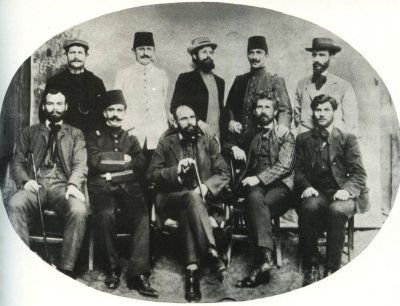
The one on the bottom shows Yane (Jane) Sandanski, one of the leaders in the uprising, having his pictures taken with "Young Turk" officers of the 1908 Young Turk Revolution. Five years separate the two pictures. It demonstrates the human capacity to look to the future to shape a new world rather that dwell on the hatreds of the past ... even in the Balkans.


Dimo Hadzhi Dimov, Yane Sandanski, Todor Panitsa with Young Turks

Sandanski gave up the armed struggle and formed "The People's Federative Party" to fight for Macedonian rights in the new Ottoman Parliament. Well, you know that this is the Balkans, and people do not live happily ever after. The Young Turks moved in a nationalist direction and began repressing minorities eventually leading the the "The Armenian Massacres" or more accurately "The Armenian Genocide".

Sandanski went back to the mountains and resumed the armed struggle. He managed to survive the Young Turks and the Balkan Wars in 1912, only to be assassinated
in 1915 by agents of the Bulgarian Tsar Ferdinand who were ... you guessed it ... ethnic Macedonians.

So it goes.

Monday, October 29, 2007

Chuck Sudetic on the "Real Macedonian Issue" Circa 1994

By David Edenden

Chuck, it's about human rights, not real estate.

It is painful to read this 1994 article on the Macedonians in Greece by New York Times journalist Chuck Sudetic, who is of Croatian ancestry, and should know better since he could easily communicate with the Macedonians in Greece.

When the Serbs were trying to ethnically cleanse Bosnia, they were using Greece's treatment of ethnic Macedonians as a model. Too bad Sudetic did not realize this at the time. He might have written more sympathetically about Macedonians. Did it even occur to him to ask why 50,000 Macedonians in Greece were not aggressively pursuing their rights? Why didn't they have any rights to begin with?Did it ever occur to him that, Greece's values regarding Macedonian rights were Nato values. Maybe he could have bought a clue and use that to report on why Nato failed in Bosnia.

Later on he wrote Blood And Vengeance about his war time experiences in Yugoslavia. I wonder if a more hard headed analysis of Greek minority rights policy, instead of this puff piece, would have made a difference.

I really don't know.
Real 'Macedonia' Issue Is Real Estate -
Edessa Journal;
New York Times:

Published: March 12, 1994

To the rest of the world, the fight between Greece and its neighboring former Yugoslav republic over the name Macedonia may make little sense. But to Metropolitan Chrysostomos, who lives on one side of the border, and to Risto Yatchev, who lives on the other side, it comes down to a battle for land.

When Yugoslavia's southernmost republic declared itself the independent state of Macedonia in September 1991, Greece slapped a trade blockade on it. Thousands of demonstrators took to the streets in Greece to protest the use of the name.

Contending that the former Yugoslav republic's leaders have pilfered part of the essentially Greek legacy of the Macedon of Alexander the Great, including his sun symbol on their flag, Greeks have whipped up their nationalist passions to a frenzy.

Outsiders ask why a name or a 2,300-year-old symbol on a flag could make a difference, and what threat a rundown, landlocked country with three rusty tanks could pose to Greece, a member of NATO and the European Union.

For northern Greeks, however, the Macedonian Republic's actions represent a threat to their land. Over a million of them belong to families that were torn from their homes in Turkey and Bulgaria between the two world wars and ended up resettling here. 'A Question of Property'

And for thousands of Macedonian Slavs driven from Greece into the Yugoslav republic 45 years ago, the real issue is also real estate: the return of land Athens confiscated from them during the 1946-49 Greek civil war.

"It isn't just a question of the name or the flag," said Mr. Yatchev, a Macedonian Slav writer who was born in Greece but now lives in Skopje, capital of the Macedonian republic. "It's a question of the property."

"I had a house, 14 fields, a couple of vineyards and a chestnut grove," Mr. Yatchev said, referring to land just outside Edessa that the Greek Government confiscated because his family members fought with the defeated Communist forces in the civil war. "It was my family's property for 300 years, and I want it back."

"It belongs to future generations," he said, expressing the almost mystical link to ancestral lands that is felt strongly by both Greeks and Slavs.

Western analysts fear that Macedonia could produce the next chapter in the long and bloody history of demographic shifts in the Balkans.

Macedonia is a mostly mountainous region divided among Greece, Bulgaria and the Macedonian Republic. The population of the new country is mostly Macedonian-speaking Slavs, with Albanian, Greek, Turkish, Serbo-Croatian-speaking Slavic, Romanian-speaking Vlah and Gypsy minorities. On the Greek side of the border, the United States State Department estimates, there are anywhere from 10,000 to 50,000 Slavs, a few of whom are fighting for official recognition as Macedonian Slavs.

Greeks have denied for decades that Slavs are Macedonians.

The Skopje Government asserts that Greece is conspiring with Serbia to spark unrest that could lead to civil war and partitioning of the new country among Serbia, Albania and perhaps even Bulgaria.

But Greece says the Skopje Government's choice of a name and a flag reveals territorial pretensions on the richest of the region's land.

"All this history, all these wars, all these exchanges of population have taught the Greeks here to fear that these threats to our territory are real," said Metropolitan Chrysostomos, the Greek Orthodox prelate in Edessa, whose parents were among the Greek refugees from Turkey who moved into the homes of Turks driven from here seven decades ago. "So many Greeks here have in their personal memory the loss of their homes in Asia Minor." Wave of Greek Settlers

After 500 years of Ottoman rule, which ended in 1912, Greeks were a minority in Greece's swath of Macedonia. The influx of Greek refugees from Turkey in the 1920's altered the ethnic makeup, and by 1928, censuses say, almost half of Macedonia's residents were resettled Greek refugees.

Drawn by promises of autonomy, Slavic Macedonians constituted about 40 percent of the Communist-led insurgency during the closing stages of the Greek civil war.

During and after the war, about 200,000 people, Greeks and Slavs alike, fled to Yugoslavia and elsewhere in the Soviet bloc. Greeks loyal to Athens were rewarded with the property of those who fled.

"This land is ours," said Nikolaos Karamanavis, a Greek journalist. "When they steal our name, it is a clear sign that they want to steal our land."

Macedonian Slavs ridicule the idea that they could be any threat to Greece. But some concede that Greek recognition of the Macedonian Republic would constitute recognition of the Slavic minority in Greece as well as property rights of the Slavs whose land was confiscated.

In 1982, the Greek Government decreed that all ethnic Greeks who fled after the civil war could return, and a 1985 decree permitted them to claim compensation for their property. Macedonian Slavs who fled were not allowed to return or to reclaim property.

Kole Mangov, a Skopje-based lawyer, said Macedonia's Government already had the names of some 5,000 Macedonian Slavs who have appealed for the return of land in Greece.

"You can't ethnically cleanse property rights," said Slobodan Casule, one the new country's journalists. "Imagine all the businesses over there that have been operating on land to which the owners do not really hold clear title. And imagine that one day, all of a sudden, the real title-holder shows up."

Athanasios Parisis, a Macedonian Slav living in Greece, says he sees the conflict getting worse. "Our Macedonian Slavs tell the Greeks to go back to Turkey," he said. "The Greeks tell us that there is only room for Greeks here. I am afraid this place will become a little Bosnia -- again."

Friday, October 19, 2007

The Economist: Turkey, Armenia, Iraq and the Kurds

By David Edenden

A long and informative article from the Economist on the "Armenian Genocide" resolution in the US Congress and Turkish vote to invade Iraqi Kurdistan. Like Macedonians in Greece, Kurds in Turkey have also been subjected to "Denying Ethnicity" ( Macedonians) (Kurds). Below are a few weasel words about current Turkish policy towards its Kurdish minority. It makes you want to spit!


Turkey and America |
Unearthing the past, endangering the future |
Economist.com: Oct. 18, 2007

"If Turkey wants to fulfill its dreams of being a regional power and an inspiring example of how Islam and democracy can co-exist, it must make peace with all its citizens, including its Kurds. And it should find a way to face up to its past. It could do worse than seek inspiration from Ataturk who, as Mr Akcam noted in a recent book, once called the Armenian tragedy “a shameful act”."

Thursday, October 18, 2007

Samantha Power - One More Time

Dear Samantha Power
From: David Edenden

I just read your article (below) about the the Armenian genocide resolution of the US Congress. To those who say that the killing of the Armenians by the "Young Turks" in 1915 does not rise to the level of a genocide, then they have stripped the word "genocide" of all its' meaning.

I know I am getting repetitive, but what about the plight of ethnic Macedonians in Greece. The US Congress, Barack Obama, and yourself have taken an anti-Macedonian stance that is akin to supporting cultural genocide. I am not impressed.

Greece's values regarding minority rights are EU values; are Nato values; are US values; are "Greek Issues Caucus" values; are Senator Barack Obama values; and finally are your values. I am not impressed.

To think that the US Congress, will provide some moral authority on "genocide issues" is nonsense since it responds only to political lobbying (as you correctly note), not sober solomonic like reflection. I am not impressed.

In this case, they have may determine that Armenians should get the elevator while the Turks get the shaft. In the past with regard to Kurdish rights in Turkey, the Turks get the elevator while the Kurds get the shaft. Go figure.

Samantha, honesty is the best policy, let have a little from Obama and from you!

The U.S. and Turkey: Honesty Is the Best Policy
Samantha Power, time Magazine, Oct 18, 2007

Ninety-two years ago, the "Young Turk" regime ordered the executions of Armenian civic leaders and intellectuals, and Turkish soldiers and militia forced the Armenian population to march into the desert, where more than a million died by bayonet or starvation
...
But this month in Washington these historical truths — about events carried out on another continent, in another century — are igniting controversy among politicians as if the harms were unsubstantiated, local and recent. At stake, of course, is the question of whether the U.S. House of Representatives should offend Turkey by passing a resolution condemning the "Armenian genocide" of 1915.
...
While it is essential to ensure that Turkey continues to "treat the Americans all right," a stable, fruitful, 21st century relationship cannot be built on a lie.

Sunday, October 14, 2007

Books by Michael Seraphinoff

Books by Michael Seraphinoff:


This Land We Do Not GiveThis Land We Do Not Give
by Michael Seraphinoff and Chris Stefou
Original work, Nonfiction
Paperback, 270 pages
US $10; Canada $10
US orders: email Michael Seraphinoff
or call (360) 678-4168
Canada orders: Oshchima

In this book you will hear the authentic voices of the people of Macedonia, voices that to this day have been drowned out by the stronger voices of those Balkan neighbors with territorial claims on the land of their Macedonian neighbors. Authors Michael Seraphinoff and Chris Stefou chronicle Macedonian resistance to foreign occupation beginning in 1389 with the Battle of Kosovo and the Turkish conquest of the independent Balkan kingdoms and ending with the history of the most recent war in Macedonia in the year 2001.

To get your signed copy or for purchases of 10 books or more, email or (360) 678-4168


Some Great Old Stories from the Old Country - MacedoniaSome Great Old Stories
From the Old Country – Macedonia
Translated, illustrated by Michael Seraphinoff
Paperback, 31 pages
US $8; Canada $10
US orders: amazon.com
Canada orders: Canadian Macedonian
Historical Society

The stories in this book are great old stories from the oral folk tradition of the ancient land of Macedonia. They are meant to make us laugh and to make us think. They are fun to share with both young and old. The authors of this collection of stories are unknown Macedonian storytellers.

To get your signed copy or for purchases of 10 books or more, order directly from the author: email or (360) 678-4168


The Legend of Kalesh AndjaThe Legend of Kalesh Andja
A novel by Stale Popov
Translated by Michael Seraphinoff
Paperback, 200 pages
US $10; Canada $15
US orders: amazon.com
Canada orders: Canadian Macedonian
Historical Society

The author Stale Popov was born in a small isolated mountain village of Macedonia in the final, turbulent decades of the Turkish Empire. From this background he is able to write a story for us in a voice of the traditional village storyteller that takes us on a journey into the heart and soul of the medieval Turkish Empire in Europe. His story of the brave peasant girl Andja is based on an old legend and a documented peasant rebellion against Turkish rule in the year 1565 in the Mariovo region of Macedonia. Popov offers us a window into a world and a way of life that is foreign to us today. And yet, The Legend of Kalesh Andja’s story of a struggle for freedom and justice, from far away and long ago, can still move readers, both young and
old.

To get your signed copy or for purchases of 10 books or more, order directly from the author: email or (360) 678-4168


Macedonian GoldMacedonian Gold
by Michael Seraphinoff
Original work, Fiction
Paperback, 182 pages
US $12; Canada $15
US orders: amazon.com
Canada orders: Canadian Macedonian
Historical Society

“What if” is the beginning of the creative process as there is a degree of possibility, no matter how miniscule. Seraphinoff’s book is fiction, though based on a historical certainty: the tomb of Alexander the Great has never been discovered. But suppose an archeological dig discovered it in Macedonia, and not Greece? An anthropologist from an American university joins forces with a Macedonian team to delve into the discovery. Seraphinoff embellishes the storyline with authentic details about Macedonian culture. The reader is carried along with the plot while getting a healthy dose of history for this part of the Balkans.

Mysterious and ancient cults, a strange language spoken by a particular segment of the population makes this a fascinating story. The history is easily digested as familiar surroundings in Macedonia are mentioned. And even if you know nothing about Macedonia and its history, and just love a good mystery, you will enjoy this novel.

To get your signed copy or for purchases of 10 books or more, order directly from the author: email or (360) 678-4168


The Nineteeth Century Macedonian Awakening: A Study of the Life and Works of Kiril PejchinovichThe Nineteenth Century Macedonian Awakening:
A Study of the Life and Works of Kiril Pejchinovich

by Michael Seraphinoff
Hardcover, 184 pages
US $50
To order: amazon.com

“The dissertation presented by Michael Seraphinoff is the first effort to present the life and work of Kiril Pejchinovich to the English-speaking world. Pejchinovich is regarded by many to be the founder of modern Macedonian literature and one of the earliest writers to use the dialect that lies at the base of the modern Macedonian literary language. ... Mr. Seraphinoff seeks to establish Pejchinovich’s position in American studies of Balkan culture. He brings together all the rather sparse facts that are known about Pejchinovich’s life and his literary activities, and these constitute a contribution to our understanding of the complicated emergence of Macedonian letters from the cultural backwaters that were the heritage of the Ottoman Empire in the Balkans. The linguistic identity of the Macedonians and their creation of a distinct cultural realm in the center of the peninsula are not just historical questions, as the writer points out: they are topics that still reverberate throughout the area today ...”

— from the report of the Dissertation Reading Committee, Deptartment of Slavic Languages and Literature, University of Washington, August 12, 1993

Monday, July 02, 2007

Politecon Publishers in Austrailia

Pollitecon Publications has updated its web site including a number of
new, free articles.

The Life in Aegean Macedonia section has a new free report:
The Human Rights Situation of Macedonians in Greece and Australia:
Submission to the Joint Standing Committee on Foreign Affairs, Defence
and Trade: Human Rights Sub-Committee

This extensive report was submitted to the Australian Government by the
Aegean Macedonian Association of Australia in 1993 and the text is now
available in its original format. The report is as relevant as when it
was first submitted.

The report is at
http://www.pollitecon.com/html/life/index.html

The Macedonian Communities Around The World section continues to develop
and has been updated with several new places and includes a growing
number of links and contact details, especially for Australia. The link
for Northern NSW includes a link to a history of the Macedonians in the
northern NSW region.

See
http://www.pollitecon.com/html/communities/index.html

The Reprints section features the reprinting of the Makedonska Iskra
newspaper from 1946 to 1957. The reprint is now complete, and of the 105
editions of Makedonska Iskra that were originally published, 102 have
been reprinted. Only three editions are missing: January 1953, June 1955
and December 1955.

The project took just over one year to complete, and required Pollitecon
to upgrade the hosting for its web site to accommodate the nearly 500
images and more than 200 megabytes of data.

On behalf of Pollitecon Publications, I would like to thank the
following people for their work on the project:
Michael Veloskey of Sydney for making the original newspapers available;
Blagoja Stojanovski of Melbourne who provided photocopies of four
missing editions;
Lubi Uzunovski of Toronto, who runs the MakNews web site, for his
technical advice on how to best present the images; and
Ye Xin Liu and Simon Yang, my two editorial assistants, for their work
in photocopying, scanning, preparing and uploading the many hundreds of
images.

Makedonska Iskra can be accessed at
http://www.pollitecon.com/html/reprints/index.html

The Essays section has been updated with three speeches:
The Speech for the Launch of A Girl Form Neret,
The Speech for the Launch of From War to Whittlesea,
The Speech for the Launch in Sydney of The Descendants of Alexander The
Great of Macedon, by author Alexander Donski.
There is also a radio interview with myself on the occasion of the
recent visit to Australia by the Greek prime minister.

The speeches and interview are at:
http://www.pollitecon.com/html/essays/index.html

The Links section includes a new and growing section of links to Books
And Sites By Other Publishers. Among these are four free books on the
history of the Balkans by the Southeast European Joint History Project.

See
http://www.pollitecon.com/html/links/links.html

And I am pleased to say that Pollitecon's newest book, A Girl From
Neret, is selling very well and I have received many excellent comments from
readers.


Information about the book is at
http://www.pollitecon.com/html/books/index.html

Finally, Pollitecon has several other book manuscripts in process along
with a new free reprint of a book under way and these should be ready
later this year.

Thank you for your continued interest.

Yours faithfully

Victor Bivell
Editor
Pollitecon Publications
PO Box W102
Abbotsford NSW 2046 Australia
Web http://www.pollitecon.com

Monday, March 19, 2007

Hitlerite Propaganda and "The Name Issue"

Just before Hitler invaded Yugoslavia in WW2, newspapers in Germany were reporting that "Yugoslav warmongers" were planning to attack Germany. The Greek newspaper Kathimerini is not telling the truth. Greece, not Macedonia, wants sole possession of the Macedonian name. That is what this whole dispute is all about.

Macedonians like to share.

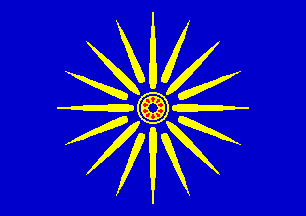
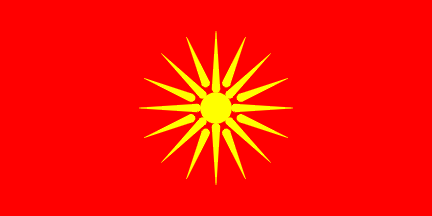
Keep your blue starburst flag, let up have the red starburst flag.
Keep your "province of Macedonia", let us keep the "Republic of Macedonia".
Keep your "University of Macedonia", let us keep " Alexander the Great Airport"


The Macedonian Ambassador to Washington should consider asking the US "Congressional Research Office" to investigative this claim. While they are at it, they can look at both Macedonian and Greek textbooks, and Macedonian and Greek minority rights policies.


Kathimerini: Skopje Government wants to present Macedonia as sole successor of Ancient Macedonia
Macedonian_News_Service : Message: Daily Bulletin:

Athens, March 13 (MIA) - After renaming the Skopje airport from Petrovec to Alexander the Great, the north-neighbouring Government has also 'mobilised' the archaeological artifacts in its possession, trying to present Macedonia at an international plan as primary, if not sole successor to the historical and cultural heritage of Ancient Macedonia, Athens-based Kathimerini writes.

- In the lobby of Macedonian Government's building, eight big statues from the Greek-Roman period are displayed, which are, according to unofficial statements by Skopje archaeologists, authentic and transferred from museums, Kathimerini reports.

The article's author writes that 'these activities are in line with the ideology by the ruling party, which is tightly connected with the nationalism of the past, since it has derived from the secession of the renowned VMRO-DPMNE'.

The author underlines that Macedonian Foreign Affairs Minister Antonio Milososki has recently dubbed the name dispute as two-party issue and states that no other organization than the UN may undertake the responsibility to review two-party issues."

Unity Regarding Name Issue

It looks like my concerns regarding the Macedonia issue was unfounded. My apologies to all concerned.

Macedonia confirms unity on name dispute with Greece
Makfax vesnik:

Skopje /16.03/ 14:49

Macedonian top officials reaffirmed their unity on the name dispute with Greece.

This was announced after today's coordinative meeting among President Branko Crvenkovski, Prime Minister Nikola Gruevski and Foreign Minister Antonio Miloshoski.

'...The sole position and strategy of the Republic of Macedonia on overcoming the name difference was reaffirmed, as one of the highest state's priorities and prerequisite for preserving the constitutional name of the country', says the joint press statement released after the meeting that was attended also by the Macedonian Special Envoy over this issue, Ambassador Nikola Dimitrov.

The announcement further says that the meeting was aimed at 'mutual briefing on the current developments and coordination on this issue of highest state interest'.

Crvenkovski-Gruevski meeting comes in a time of strained relations between Athens and Skopje, but also in time of tension in the dialogue between the Prime Minister and the President.

Yesterday, the Government sent to Greece a note of protest relating offending behavior of some of their soldiers towards Macedonia.

Previously, Greece raised objections over renaming of the Skopje Airport into Alexander the Great."

Friday, March 16, 2007

More Pressure on Name Issue

I am very leery of closed door meetings to arrive at a consensus and then have the "compromise" foisted on the unsuspecting public. A forum on TV with the leaders of the Macedonian Orthodox Church and leading professors and journalists should be held inform the public of the crucial negotiations that are taking place with the US/EU to get a unified consensus on what is to be done.

"President and premier to hold consultation over name dispute with Greece
Makfax vesnik:

Skopje /16/03/ 08:22

President Branko Crvenkovski and Prime Minister Nikola Gruevski are due to hold consultation today aimed at defining the future steps of Macedonia regarding the name dispute with Greece.

According to the announcements, Foreign Minister Antonio Miloshoski and the Macedonian negotiator Nikola Dimitrov will also attend the meeting.

Yesterday, the Government sent to Greece a note of protest relating offending behavior of some of their soldiers towards Macedonia.

Previously, Greece raised objections over renaming of the Skopje Airport into Alexander the Great.

Greece's media reported that the local parties are very likely to use the name dispute for propaganda purposes during the 2008 election campaign."

Thursday, March 15, 2007

ABC News Misses the Point

ABC News should go to Florina (Lerin) to interview ethnic Macedonians to ask how it feels living in a country with this type of atmosphere.Amelia Newcomb pick up the ball and get in the game for god's sake.

ABC News: Reporters on the Job:

' …And Writing the Later Drafts: For correspondent Nicole Itano, clashing views of history in the Balkans is not confined to the classroom (see story). The taxi driver she uses to get around Athens, for example, will order passengers to get out if they refer to the Former Yugoslav Republic of Macedonia (FYRM) as simply 'Macedonia.' The reason: Greeks say that the kingdom of Alexander the Great, known as Macedonia, was part of present-day Greece. 'Many Greeks are upset at what they see as an attempt by a Slavic country to appropriate his legacy for itself,' Nicole says.

During a Greek broadcast of a soccer match between England and Macedonia, Nicole says, the station superimposed the letters FYRM (pronounced 'feerim') to 'correct' the scoreboard's rendering of the teams: ENG vs. MAC. 'That's how touchy these issues are,' she says.

Amelia Newcomb
Deputy world editor"

Tuesday, March 13, 2007

Danforth Comes to the Rescue

Danforth is the name of a street in Toronto where Macedonians and Greeks live and sometimes go out to play "kick your ass" over a statue of Alexander the Great. It is also the name of Loring Danforth, a professor of anthropology at Bates college. The link below is from last summer, so Danforth has already completed his interviews and is now in the process of writing his book. Looking forward to reading it.

Bates College | Loring Danforth:

"In late August, Danforth travels to Toronto where he will conduct interviews with child refugees from the Greek Civil War. He has focused much of his scholarly attention on Greece, Macedonia and Australia. His award-winning book 'The Macedonian Conflict: Ethnic Nationalism in a Transnational World' (Princeton University Press, 1996) concerns the claims to and construction of Macedonian identity in Northern Greece and Australia. He is also the author of 'The Death Rituals of Rural Greece' and 'Firewalking and Religious Healing: The Anastenaria of Greece and the American Firewalking Movement,' both published by Princeton University Press."

Tuesday, March 06, 2007

Should "Ethnicity Denial" of Macedonians be Made a Crime?

By David Edenden 


Can some shit-disturbing, non-conformist, pain-in-the-butt, euro-trash MP in the EU Parliament introduce a law that makes it a crime to promote "Ethnicity Denial" of Macedonians. We need more made to order laws like this one for Armenians in Switzerland.

This Swiss law about Armenians is very interesting. It is specifically designed to be ant-Turkish at a time when Turkey is trying to enter the EU. It seems to be against the law to deny the Armenian genocide, but it is OK to deny the existence of Kurds in Turkey and Macedonians in Greece. 

If you have enough lobby power and it is in the interests of certain groups, you can get a law made to order, while your country happily ignores the rights of others. Laws for the benefit of Armenians are being passed in France and in the US. 

It is funny (but not hilarious) that one of the US politicians, Rep. Adam Schiff, who advocated for the Armenians is also denying the existence of Macedonians in Greece. It is a human condition to be a hypocrite but I guess this guy's motto is "you can't be too big of a hypocrite".

My suggestion "take the log out of your own eye before complaining about the sliver in someone elses' eye".

Swiss 'genocide' trial for Turk:
BBC NEWS | Europe |


"Swiss 'genocide' trial for Turk Dogu Perincek

Dogu Perincek's case risks straining Swiss-Turkish relations
A Turkish nationalist leader has gone on trial in Switzerland for denying that the mass killings of Armenians in Turkey in 1915 amounted to 'genocide'.

Dogu Perincek, 65, is accused under Swiss law of racial discrimination.

The Swiss parliament, along with more than a dozen countries, recognizes the killings as 'genocide'. Turkey firmly rejects the 'genocide' allegation."

Sunday, February 18, 2007

Patriot Games

This is an old story from our friend Fiachra about Colin Farrell's Alexander. I saw the movie. Not much of a story, just enough to make Macedonians and Greeks look foolish. Wouldn't be proper to mention the role of US/EU in this comedy. Wouldn't be prudent!. People are watching! Mum's the word.

Patriot games

Which people are the true descendants of the greatest military
commander in history? Fiachra Gibbons reports on how Oliver Stone's
epic Alexander is reigniting an ancient, bitter feud.

Friday November 19, 2004
The Guardian

The first western imperialist ... Colin Farrell as Alexander

"We will come and kill you in your beds, cut your throats, and wipe
you from the face of the earth ... if Alexander the Great were alive
today he would grind you gypsy dogs into the dust, dig your dead from
their graves and silence forever your filthy language that insults his
name ..."

Internet chatrooms have never been the most decorous of forums but
even in the free-for-all that is cyberspace, those dedicated to
discussing Oliver Stone's new film, Alexander, are a case apart.

Since the combative director of JFK chose to make his first foray into
historical epics with a biopic of the most fought-over figure of the
ancient world, rivers of blood have been spilt - figuratively at least
- in a propaganda battle between Greek and Macedonian nationalists
over who has the right to claim the all-conquering hero as their own.

This very modern ethnic turf war is being fought with tortuously
argued historical blogs about which Macedonia Alexander conquered the
known world for - a tiny new Balkan republic that has only recently
come to see itself as the keeper of his flame, or a province that was
officially known as "Northern Greece" until the former Yugoslav
republic of Macedonia declared itself independent and bagged the name.

But the real blood and guts of the battle, the part Alexander would
have so enjoyed, is in the chatrooms, where fanatical foot- soldiers
taunt each other with blood-curdling threats heavy with echoes of the
short but brutish Balkan wars that carved up ancient land between
Greece, Serbia and Bulgaria almost a century ago.

Stone has remained uncharacteristically silent, preferring to wrestle
on set with war elephants and his leading man, Colin Farrell. Even for
such a seasoned controversialist, this is a scrap to stand back from.

For the struggle over who have the right to call themselves
descendents of the greatest military commander in history, and the
first real western imperialist, is neither pretty nor edifying. In the
early 1990s, Greece nearly invaded the newborn Republic of Macedonia
for "stealing" Alexander's symbol, the Star of Vergina, for its flag,
as well as the White Tower in the Greek Macedonian capital of
Thessaloniki for its banknotes, something the millions of ordinary
Greeks who took to the streets saw as "blatant acts of aggression".

The flag and the banknotes were hastily withdrawn, but Greek pride was
far from restored. To the horror of its European partners, Athens
briefly contemplated carving up its defenceless northern neighbour
with the Serbian dictator Slobodan Milosevic. In the end, Greece
stepped back, choosing instead to blockade the tiny republic of barely
two million people in an attempt to strangle it at birth. Since then
millions have been spent on a war of attrition to claim the name - and
Alexander - back.

You cannot walk more than a few hundred metres in any town in northern
Greece without tripping over a new statue, bust or monument to
Alexander, who extended the Hellenic world as far as India in the
fourth century BC with such slaughter that even today in Iran and
central Asia his name is used to scare unruly children. You will find
the most pointed statue of all at the border with Macedonia at Niki -
named after the Greek god of victory - where a giant Alexander angrily
brandishes a javelin at the upstart state across the frontier.

All over Greek Macedonia, streets, schools and airports have been
hastily renamed, while archaeologists, having all but ignored ancient
Macedonia until relatively recently, are digging furiously for its
traces. The spectacular tomb of Alexander's father, Phillip, at
Vergina near Thessaloniki, and the city's revamped museum, hammer home
the kingdom's Greekness.

Still, passions had cooled somewhat after an unhappy compromise over
the name that burdened Skopje with the cumbersome temporary moniker of
the Former Yugoslav Republic of Macedonia, or "Fyrom" for short. Greek
investment also began to build bridges - until Stone and his army of
Hollywood stars appeared on the horizon to put nationalists on both
sides back on a hair-trigger.

It is into this fraught and febrile atmosphere that George W Bush has
now wandered. With the world waiting and wondering where the president
will start the next war, Bush chose as his first major foreign-policy
decision of his second term to recognise Fyrom by its "proper" name as
the Republic of Macedonia, prompting paroxysms of Greeks anger across
the globe and Athens to vow to block Macedonia's entry into the EU and
Nato.

Even before Bush's intervention, the very mention of the M-word in
Greek Macedonia risked a stern lecture on how it has been Greek since
antiquity. I nearly lost an ear to a particularly patriotic barber in
Thessaloniki last month when I mentioned that I had just arrived from
the "other Macedonia".

Those people are not Macedonian, he raged. "That is a Slav lie. We are
the real Macedonians. They are prostitutes and Gypsies and worse than
Albanians," he declared. His family, it turned out, were recent Greek
immigrants from Georgia who, he claimed, went "east with Alexander".
He liked to take his son on Sundays to the massive equestrian statue
of Alexander on the city's seafront promenade, where Greek
right-wingers gathered after Bush's bombshell to burn American and
Macedonian flags. "I tell him to be proud of his ancestors and how
lucky he is to have returned to the land of his forefathers."

But ask anyone four hours north in Skopje what Alexander was and they
will smile sheepishly and say, "Macedonian, of course!" And when
pressed about the obvious absurdity of a country that has a majority
Slavic population claiming a man who was born nearly 1,000 years
before the first Slav appeared in Macedonia, they answer, "Well, he
was certainly not Greek."

If the Macedonians were Greek, why did Alexander have to address his
troops in both Greek and ancient Macedonian, they argue. And every dog
can quote the Athenian orator Demosthenes' famous condemnation of
Alexander's father Philip as "not only no Greek, nor related to the
Greeks, but not even a barbarian from any place that can be named with
honour, but a pestilent knave from Macedonia, whence it was never yet
possible to buy a decent slave."

"No one is saying that Alexander spoke modern Macedonian, that is
ridiculous, but who is to say that there isn't something of him still
floating around in the genome," says Vojislav Sarakinski, a lecturer
in ancient history at the city's main Cyril and Methodius university.
It is easy to ridicule all this as archetypical Balkan lunacy until
you realise how much of the emotional heat of the dispute stems from
the insecurity of both countries about their borders, fears fully
justified by the region's recent history.

Stone has been well aware of these sensitivities from the start,
though initial Greek outrage at his film focused on Alexander's
omnivorous sexuality, in particular his fondness for eunuchs. His
film, he insists, is purely about the historical "man god", and so has
made no secret of showing Alexander's love for his friend Hephaestion.
There is, however, none of the lurid decadence promised from Baz
Luhrmann's planned film about Alexander, if it ever gets off the
blocks.

Evangelos Venizelos, the formidable former Greek culture minister and
a Macedonian, attempted to get Stone onside early on, offering him
Greek locations and the use of the army for battle scenes, but the
director demurred and instead diplomatically chose locations far away
from controversy in Morocco and Thailand. Confronted with angry MPs
unhappy with what they were hearing about Alexander's bisexuality,
Venizelos despaired, "What can I do? It's Hollywood."

Generally, though, most Greeks see the Stone film as a chance to
strike a blow against Skopje, given that it is based on the biography
by the Oxford academic Robin Lane Fox, whom both sides see as a
Hellenist.

None of the previous, deeply disappointing attempts to bring
Alexander's extraordinary life to the screen have had to walk the same
tightrope because, until Skopje broke away from Belgrade in 1991,
Alexander's origins were not in dispute. In fact he barely figured in
the old Yugoslav textbooks, and even in Greece he was something of a
forgotten figure - relegated to the second and third division of
Hellenic heroes behind Pericles, the great philosophers, and warriors
such as Leonidas. While the great Greek director Theo Angelopoulos
dealt obliquely with him in his film about a 19th-century Macedonian
brigand, Megalexandros, there has been no biopic in either country.

"Alexander lived long before nationalism and so is our common hero,"
says Vasil Tupurkovski, a former deputy president, who has written
four popular histories about him. "He would be laughing at us arguing
about him now."

Ah, but would he be laughing in Greek or Macedonian? Professor Nade
Proeva, the expert on ancient Macedonia in Skopje, thinks both.
"Alexander certainly spoke and wrote Greek, but then it was the lingua
franca of the time, like English is now. I speak French but that does
not make me French."

With such treacherous ground to negotiate, and amid thunderous
lobbying from both sides, Stone has chosen a remarkably adroit middle
course. His masterstroke has been to give Alexander and the men of the
Macedonian phalanxes Irish accents, while the Greeks speak clipped
English RP.

Macedonians of all complexions are content with this, each convinced
it favours their cause. So in another two millennia when people ponder
again the origins of the mysterious Macedonian who emerged from the
southern Balkans to rule the world at 25, they will turn their ears to
Colin Farrell's guttural brogue and conclude that he was in fact a
Dubliner.

· Alexander opens in the US next week and in the UK in January.