The Macedonian Tendency: Book Reviews
Showing posts with label Book Reviews. Show all posts

Thursday, November 01, 2007

New Book: This Land We Do Not Give

Macedonian_News_Service

Dear readers and friends,

It gives me great pleasure to introduce to you a new book This Land We Do Not Give co-authored by Dr. Michael Seraphinoff and Chris Stefou.

This book chronicles the Macedonian people resistance to foreign occupation beginning in 1389 with the Battle of Kosovo and the Turkish conquest of the independent Balkan kingdoms and ending with the history of the most recent war in Macedonia in the year 2001.

For most people the name Macedonia immediately brings to mind the ancient world conquerors led by their daring and charismatic young warrior-king Alexander, who is the subject of so much legend and lore. However, for Europeans Macedonia is known in modern times as the "apple of discord" among southeastern European nations.

By the late 19th century the Ottoman Turkish Empire had lost nearly all of its European colonies. The bulk of what remained was the Ottoman province that was the ancient land of Macedonia. The people of Macedonia at that time were predominantly of a single ethnic group defined by their language, which is a distinct set of Slavic dialects, and their Eastern Orthodox Christian faith, both of which are clearly documented in church manuscripts dating as far back as the 9th century on the Balkan peninsula.

Thus, the Macedonians were in a position to self-organize to resist the foreign rule. However, that resistance was tragically manipulated by their recently liberated neighbors in Serbia, Bulgaria and Greece. They saw the future liberation of Macedonia more as an opportunity to expand their own nation-states' borders at the expense of that neighbor than an opportunity to help free one more oppressed Balkan people, despite the fact that all three of those states had achieved their own independence only with aid from outside.

That outside aid had come primarily from the Great Powers of Europe, the Germans, the British, the French and the Russians. The Macedonians, however, while they had the sympathy of most of the people of Europe, were unable to gain the support of any of the governments of Europe for their liberation, because those governments shifted positions and alliances in endless pursuit of further power and influence. Thus, Macedonia has a history not unlike that of other "troubled" regions of Europe, such as the regions of Spain and France inhabited by the Basques or the former island colony of the British Empire, Ireland, where the negative consequences of colonialism are still a fact of life.

As we know, the victors enjoy the various spoils of war, and one of these is the opportunity to have their version of the history of the war broadly and boldly disseminated. So it has been for over a hundred and fifty years that Macedonian history has been primarily written and disseminated by those Greek, Serbian or Bulgarian victors in the Balkan wars of liberation of the 19th and 20th centuries. Only in one small part of Macedonia that fell to socialist Yugoslavia after World War Two were the Macedonian people able to begin to tell their own story in their own words, although even there certain political considerations led to censorship.

In this book you will hear the authentic voices of the people of Macedonia, voices that to this day have been drowned out by the stronger voices of those Balkan neighbors with territorial claims on the land of their Macedonian neighbors. To add to the depth of this tragedy, too many Macedonians in past times and up to the present day have lent their own voices to this anti-Macedonian chorus as the recipients of various "gifts". Those neighbors have at times offered opportunities for social advancement for assimilation into the neighboring linguistic, ethnic, political or religious communities, and, as often, they have meted out punishment to those who refused to cooperate. Centuries ago in the Ottoman Empire one gift took the form of a "torba" or sack of grain during hard times for any Macedonian Christian willing to enter the mosque and receive the Moslem faith. Today it includes such things as new freedom to travel, which the Bulgarian government is offering any Macedonian from the Republic of Macedonia willing to accept Bulgarian citizenship.

While it is possible to understand and even sympathize at times with desperate people who have accepted such offerings, it is the great sacrifice of those who suffered terrible humiliations, hardships, torture, imprisonment, banishment, wounds both physical and mental and even death in order to resist the theft of their land, the denial of their language, their culture or their religion that is the subject of this book.

Few people in the world have endured the trials of war imposed upon the Macedonian people. They resisted the foreign Ottoman Turkish occupation for nearly five hundred years. They fought in large numbers in the Karposh Uprising in 1689. Then, in more modem times they fought and suffered in major struggles for freedom beginning in 1822 in the Negush Uprising, in 1876 in the Razlovtsi Uprising, and in 1878 in the Kresna Uprising. Macedonians rose up again in 1903 in the well-organized and widespread Ilinden Uprising. After the failure of the 1903 revolt many joined regional armies in the Balkan War of 1912 that finally ended Ottoman Turkish rule over Macedonia. Too many were also drawn into the tragic second Balkan War over division of Macedonia among the neighboring Balkan states in 1913, followed by the First World War from 1914 to 1918. In the Second World War Macedonian Partisans helped defeat the fascist occupiers of Yugoslavia and earned the right to form the first autonomous Macedonian Republic within socialist Yugoslavia in 1945. Macedonian anti-fascist Partisans in Greece would later also fight in the Greek Civil War from 1947 through 1949. Most recently Macedonians were caught up in the wars that accompanied the breakup of Yugoslavia beginning in 1991, leading finally to open warfare in Macedonia in the year 2001. The stories that you will read in this book record Macedonian resistance to foreign occupation over this entire period. This record is one answer to those who might otherwise dismiss the entire existence of the Macedonian people with something like: "What the heck is a Macedonian ?"

This is a must read book not only for Macedonians but also for non-Macedonians worldwide. Our story must be told.

There is an entire generation of young Macedonian Canadians, Americans, Australians and others who know very little of the history of their ancestors and the continuing struggles of the Macedonian people. They may hear occasional stories from
their elders, but for a much richer, fuller appreciation of their Macedonian heritage, let them read This Land We Do Not Give.

For more information on how to purchase this book click on:

http://www.macedonianlit.com/mac_pages/books.html

or on:

http://www.oshchima.com/thisland.htm

It would also make an excellent gift.

Tuesday, October 16, 2007

US Salute toMacedonian Soldiers

A salute to our gallant allies in Iraq:

FOR IMMEDIATE RELEASE
RELEASE No. 20061005-03
Oct. 5, 2006

Iraqis graduate from Macedonian SF boot camp
Multi-National Division – Baghdad PAO

By Spc. C. Terrell Turner
1st BCT PAO, 4th Inf. Div.

CAMP TAJI, Iraq
– Iraqi army soldiers from 1st Platoon, 5th Special Troops Company, 3rd Brigade, 9th Iraqi Army Division, graduated from the Macedonian-led basic combat training course Sunday at Camp Taji.

The course was designed by the Macedonian Special Forces Regiment, which is attached to 1st Battalion, 66th Armor Regiment, 1st Brigade Combat Team, 4th Infantry Division, to supplement the training the soldiers received in basic training and to allow them to better execute their daily missions alongside the Macedonian soldiers.

“For more than 16 days, we assisted the Macedonians in providing the Iraqi soldiers with additional combat training, to include marksmanship training, two ranges, a shoot house, structure clearing procedures and first aid,” said Sgt. 1st Class Russell Coughenour, noncommissioned officer-in-charge, 3rd Bde, 9th IAD Military Transition Team. “We also focused on basic discipline and noncommissioned officer development during the training.”

Six MTT members and 28 Macedonian soldiers trained the platoon of 52 Iraqi soldiers from start to finish. The platoon will return to its area of operations to conduct military operations.

“It was fabulous,” said Coughenour. “They were a refined crew by the time they were done. They’re just a super bunch of guys.”

The training came to fruition after the Macedonian SF Regt. conducted an assessment of the Iraqi forces during some initial missions.

“Our job is to assist and advise the Iraqis,” said Capt. Zoran Ivanov, contingent commander, Macedonian SF Regt. “The training will allow them to be more confident and proficient in their training.”

The Iraqis seemed to appreciate the additional instruction.

“The training was tough, but good,” said Pvt. Ali, an infantryman with 5th STC, in his second year of service in the new Iraqi army. “I learned some new skills and they taught us things like self-confidence, duty, loyalty, respect and discipline.”

The soldiers are the first to go through the training, but not the last, Ivanov noted. Two more cycles of training are scheduled, which will mean 150 Iraqi soldiers will have gone through the additional training.

“I feel good that I graduated from this course, and I hope I will be able to fight the terrorists,” said Spc. Adel, infantryman, 5th STC. “I want my nation to be at peace.”

Ivanov said he recognized an almost instant change in the soldiers after they completed the training.

“They will go back to their units and begin going on missions after this,” he said. “The soldiers displayed lots of effort. They want to learn. At the end of the training, the difference was obvious. The ‘Scorpions’ of 5th Special Troops Company are completely different soldiers.”

The next graduating class is scheduled for late October.

Sunday, October 14, 2007

Books by Michael Seraphinoff

Books by Michael Seraphinoff:


This Land We Do Not GiveThis Land We Do Not Give
by Michael Seraphinoff and Chris Stefou
Original work, Nonfiction
Paperback, 270 pages
US $10; Canada $10
US orders: email Michael Seraphinoff
or call (360) 678-4168
Canada orders: Oshchima

In this book you will hear the authentic voices of the people of Macedonia, voices that to this day have been drowned out by the stronger voices of those Balkan neighbors with territorial claims on the land of their Macedonian neighbors. Authors Michael Seraphinoff and Chris Stefou chronicle Macedonian resistance to foreign occupation beginning in 1389 with the Battle of Kosovo and the Turkish conquest of the independent Balkan kingdoms and ending with the history of the most recent war in Macedonia in the year 2001.

To get your signed copy or for purchases of 10 books or more, email or (360) 678-4168


Some Great Old Stories from the Old Country - MacedoniaSome Great Old Stories
From the Old Country – Macedonia
Translated, illustrated by Michael Seraphinoff
Paperback, 31 pages
US $8; Canada $10
US orders: amazon.com
Canada orders: Canadian Macedonian
Historical Society

The stories in this book are great old stories from the oral folk tradition of the ancient land of Macedonia. They are meant to make us laugh and to make us think. They are fun to share with both young and old. The authors of this collection of stories are unknown Macedonian storytellers.

To get your signed copy or for purchases of 10 books or more, order directly from the author: email or (360) 678-4168


The Legend of Kalesh AndjaThe Legend of Kalesh Andja
A novel by Stale Popov
Translated by Michael Seraphinoff
Paperback, 200 pages
US $10; Canada $15
US orders: amazon.com
Canada orders: Canadian Macedonian
Historical Society

The author Stale Popov was born in a small isolated mountain village of Macedonia in the final, turbulent decades of the Turkish Empire. From this background he is able to write a story for us in a voice of the traditional village storyteller that takes us on a journey into the heart and soul of the medieval Turkish Empire in Europe. His story of the brave peasant girl Andja is based on an old legend and a documented peasant rebellion against Turkish rule in the year 1565 in the Mariovo region of Macedonia. Popov offers us a window into a world and a way of life that is foreign to us today. And yet, The Legend of Kalesh Andja’s story of a struggle for freedom and justice, from far away and long ago, can still move readers, both young and
old.

To get your signed copy or for purchases of 10 books or more, order directly from the author: email or (360) 678-4168


Macedonian GoldMacedonian Gold
by Michael Seraphinoff
Original work, Fiction
Paperback, 182 pages
US $12; Canada $15
US orders: amazon.com
Canada orders: Canadian Macedonian
Historical Society

“What if” is the beginning of the creative process as there is a degree of possibility, no matter how miniscule. Seraphinoff’s book is fiction, though based on a historical certainty: the tomb of Alexander the Great has never been discovered. But suppose an archeological dig discovered it in Macedonia, and not Greece? An anthropologist from an American university joins forces with a Macedonian team to delve into the discovery. Seraphinoff embellishes the storyline with authentic details about Macedonian culture. The reader is carried along with the plot while getting a healthy dose of history for this part of the Balkans.

Mysterious and ancient cults, a strange language spoken by a particular segment of the population makes this a fascinating story. The history is easily digested as familiar surroundings in Macedonia are mentioned. And even if you know nothing about Macedonia and its history, and just love a good mystery, you will enjoy this novel.

To get your signed copy or for purchases of 10 books or more, order directly from the author: email or (360) 678-4168


The Nineteeth Century Macedonian Awakening: A Study of the Life and Works of Kiril PejchinovichThe Nineteenth Century Macedonian Awakening:
A Study of the Life and Works of Kiril Pejchinovich

by Michael Seraphinoff
Hardcover, 184 pages
US $50
To order: amazon.com

“The dissertation presented by Michael Seraphinoff is the first effort to present the life and work of Kiril Pejchinovich to the English-speaking world. Pejchinovich is regarded by many to be the founder of modern Macedonian literature and one of the earliest writers to use the dialect that lies at the base of the modern Macedonian literary language. ... Mr. Seraphinoff seeks to establish Pejchinovich’s position in American studies of Balkan culture. He brings together all the rather sparse facts that are known about Pejchinovich’s life and his literary activities, and these constitute a contribution to our understanding of the complicated emergence of Macedonian letters from the cultural backwaters that were the heritage of the Ottoman Empire in the Balkans. The linguistic identity of the Macedonians and their creation of a distinct cultural realm in the center of the peninsula are not just historical questions, as the writer points out: they are topics that still reverberate throughout the area today ...”

— from the report of the Dissertation Reading Committee, Deptartment of Slavic Languages and Literature, University of Washington, August 12, 1993

Sunday, July 15, 2007

Book Review: Hugh Garner

By David Edenden

Hugh Garner is a famous Canadian novelist who lived and wrote about "Cabbagetown", an area of Toronto where the first "Macedonian - Bulgarian" church was built . He must have been aware of the "Macedonian Question".

There is a minor character named Mike, who is a restaurateur (naturally) in the novel. These are the only references to Macedonians in the novel. Mike is Toronto's first "Grkoman" in Canadian literature - good fun.

If anyone has more information on Garner and Macedonians, don't be a stranger!

Cabbagetown by Hugh Garner is "the classic novel of the Depression inCanada" first published in 1950. MCGraw-Hill Ryerson 1968 Trade Paperback

p 234

Before putting Mrs. Plummer on the Greyhound bus for Detroit Myra found a job as a waitress in a restaurant on Queen St. West. Her boss was a short chunky man of fifty with a nearly bald head. He was a Macedonian who claimed to be a Greek, or the other way around. He wore heavy tortoise-rimmed glasses when he checked the invoices or read his New York newspaper with the queer-looking print. His name was Mike.

p 238

He told her about Greece when he was a young man there, and about driving a mule team during the Balkan War. He had arrived in Halifax with twelve dollars in his jacket and had got off the train in Toronto without knowing a soul in the city. He had seen a Macedonian name above a restaurant, had gone in and had been given a job washing dishes for his meals, tobacco and a place to sleep in the cellar. Myra found his story fascinating.

Book Review: Victor Serge

By David Edenden

Victor Serge was a famous French author of Russian descent who was a follower of Leon Trotsky. He was jailed by Stalin and then expelled from the Soviet Union after an international campaign to secure his freedom. He had an interest in the Balkans. It is a very interesting book. There are only a few pages relating to Macedonia. He wrote for many French radical papers and some of his writing may be about Macedonia, if anyone is interested in doing some research. He seemed to be friends with Dimitar Vlahov and Todor Panitza.

Victor Serge wrote about his prison years (1912-1917) in a novel called "Men in Prison". I do not know if he mentions Macedonians in that novel but he does mention them below. If someone could get a copy and post a review, it would be great. I wonder what Christopher Hitchens would have to say about Victor Serge and Macedonians?


Memoirs of a Revolutionary - University of Iowa Press ed. 2002. Translated Peter Sedgwick OUP 1963.
There is more here, and here.


P. 63-64 Paris France. 1917

One day I was arrested in the street by two terrified inspectors who for some unknown reason were expecting me to resist to the death.
...I was conveyed by administrative decision to a concentration camp at Precigne, in La Sarthe.

... Guarded by weary Territorials, who never had an idea unless it was to re-sell us bottles of wine at a handsome profit, we would hold pro- Soviet meetings in the courtyard of the secularized monastery.
...Belgians, Macedonians, and Alsatians, variegated "suspects (some of them genuinely, in fact horribly suspect), would hear us out in silence...

...The Belgians and Alsatians were vaguely pro-German; the Macedonians, proud, destitute and silent were just Macedonians, ready to fight the whole world for their primitive mountain liberty.

...one of our group tried to escape, under cover of a storm. He fell in the camp's perimeter, under the livid glare of searchlights: "Twenty years old and six bullets in his body," it was remarked. On the following day, we summoned the camp to revolt. The "Starost", or Elder of the Macedonians, came and told us that they would support us.

...The local Prefect came, and promised us an inquiry ...the revolt subsided.

P 179-180 Vienna, Austria 1925

I became interested in the movement for a Balkan Federation. The conception was noble: no other remedy was appropriate to the division of the small kindred peoples of the peninsula into feeble states, destined to be destroyed sooner or later through their mutual laceration.

The Doctor, a big white haired Bulgarian, scholarly and Parisified, would arrange appointments with me in the discreet little local cafes. A taxi, and then the tram: we would head out to the vineyards, between Floridsdorf and Modlin .

There we would meet a young stranger in an outsize overcoat, whom I immediately classified as a bodyguard; I thought I could see the enormous Browning revolver, the favorite weapon of Macedonians (who do not trust small bullets), bulging through his coat pockets.
The overcoat-man, all smiles, hurried me along urgently. The tram again, and then we came to a village full of charming taverns, and after that to a villa, adorned with flowers like its neighbors, in which lived the last surviving leader of the Communist-influenced "La Federation Balkanique" (1) a former member of the Ottoman Parliament.

...Vlahov (2) rarely goes out now. Murder lies in wait for him at every street corner, and at night trusted men stand on watch in the garden of his villa.

In this very city his predecessor, Todor Panitza, was recently killed while watching a performance in a theater. A short while before that, Panitza's predecessor, Petar Chaulev, had discovered that he was being trailed in these streets and took the train to Milan. In Milan he was murdered. A short while before that, the old leader of I.M.R.O. (Internal Macedonian Revolutionary Organization) (3), Todor Alexandroff, had been killed at the end of a conference in the mountains, in which he had advocated cooperation with the Communists. I had drafted the three obituaries for the press.

Around the great conception of a Balkan Federation, there swarmed hordes of secret agents,impresarios of irredentism, pedlars of the influential word, night-walking politicians engaged in six intrigues at a time.

And all these smart gentlemen, with their over-gaudy neckties sought to harness the unbridled energy of the Comitajis and sell it to and fro to any buyer. There was the Italian wing, the Bulgarian wing, the Yugoslav wing, two Greek tendencies, one monarchist and one republican, ideologies, personal cliques, and vendettas. We knew the cafes in which the revolvers of any given group lay in wait, watched from the café opposite by those of another.

Footnotes
(1)La Federation Balkanique: a multi-lingual review published in Vienna from 1924 and after 1931 in Frankfurt, with communist backing but a wider appeal. (It advocated a Balkan Federation including an independent Macedonia)

(2) Dimitar Vlahov, a leading Macedonian communist and Commintern delegate. After 1935 he took refuge in the Soviet Union; in 1943 emerged as a partisan leader with Tito, with special responsibility for Yugoslav Macedonia, and died in 1951 as Vice-President of Yugoslavia.

(3) I.M.R.O. was a Macedonian nationalist and terrorist organization founded in 11893 and financed by a levy on all Macedonians; it was based on local activist bodies called Comitajis which elected delegates to a national convention.

Book Review: Edmund Wilson

By David Edenden

Edmund Wilson was a famous American writer and critic whose writing spanned five decades from the 20's to the 60's. These are his memoirs from the sixties. He met a yound Macedonian student and unlike other people today in Skopje, young Ivanka Koviloska can prove that she was "rather cool about Tito" 40 years ago! If Ivanka is still with us, I would love to publish her recollections of Edmund Wilson.

Bugaromani please note that the "Macedonian dialect has been lifted to the dignity of a literary language", with the help of comrade Tito!

Wilson, Edmund, The Sixties. Harper Collins 1993

Page 232 - 1963

Ivanka Koviloska, a young woman from the University of Skopje, who is working on Scott Fitzgerald. I had already begun hearing about the Macedonian language and wondering what it was.

It seems that Tito, since 1949, has ben building up Skopje as a great industrial center, and the Macedonian dialect has been lifted to the dignity of a literary language.

One of the great authorities on it is a Harvard professor, who has written a Macedonian grammar. They have already short story writers - though no novelists - and a highly esteemed poet. it is a curious example of the growth of minority nationalisms within the big federations.

Miss Koviloska, when I said something favorable about Tito, was rather cool about him. She spoke of the bureaucracy of Belgrade, and said that she never spent much time there, merely passed through in going north.

She seemed rather proud of the fact that the language was unique among the Slavic languages in having a definite article - which seems to me - as I suppose Russian "to" and "zto" are - derived from Greek "outos" and "autos". I bought the grammar and found the language perfectly simple - the meaning, as in the cases of the other Yugoslav languages - usually recognizable from Russian. (As I write, July 27, Skopje has just been wrecked by an earthquake).

Macedonian Restaurateurs in Toronto

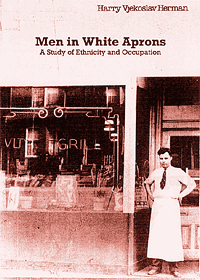
MEN IN WHITE APRONS
Lecture by Harry Vjekoslav Herman
A Study of Ethnicity and Occupations
Macedonian Restaurant Owners in Toronto Sunday, February 26th , 2006
Macedonian History - Canadian Macedonian Historical Society:

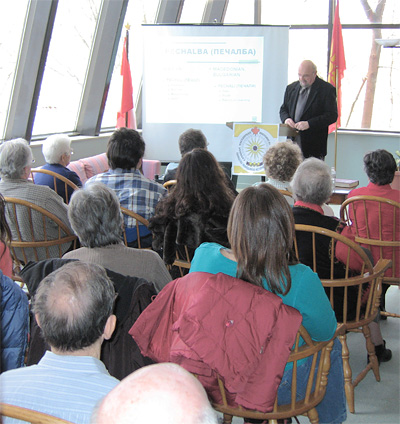
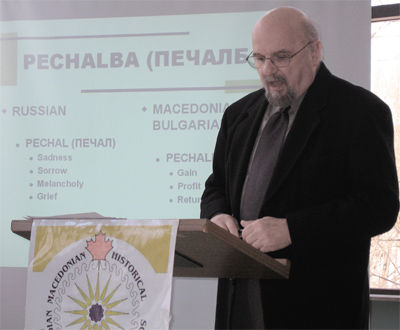
Men in White Aprons by Harry Vjekoslav Herman The domination of a particular type of occupation by one ethnic group is a phenomenon, which has been observed by many anthropologists. Harry Herman reported on his 1978 study of "Men in White Aprons": A Study of Ethnicity and Occupation. In the lecture Professor Herman explained how he went about researching material for the development of the book, which originally was prepared for his Master's dissertation. He acknowledged the success of his research to the cooperation of many Torontonians of Macedonian descent like Zorka Basil who was also at the lecture. Professor Herman focused on the concentration of Macedonian immigrants in the restaurant industry in Toronto. His main objectives were to explain the reasons for this occupational concentration, to see how it evolved and to point out its consequences for the immigrants and for their children. The political, economic and social history of Macedonian emigration and the social and economic climate in Canada at the time of their arrival was also presented. The lecture ended with engaging questions on the nature of ethnicity and how Macedonians integrated into the social and economic life of Canada. John Thomas, president of the society presented Professor Herman with an honorarium and thanked all those who attended the lecture.
The society is presently working on re-printing "Men in White Aprons" and would like to add pictures to the new edition. Anyone who has a pre-1930's picture of a Macedonian restaurant, please scan and send it to us via an e-mail attachment and include a brief description (who/what/when/where).

Professor Harry Vjekoslav Herman

Men in White Aprons Lecture

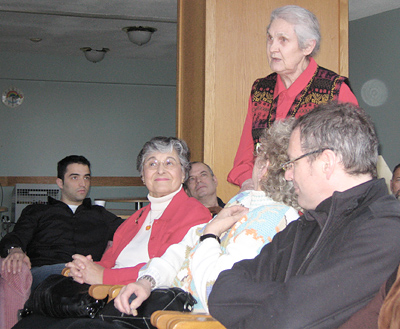
Zorka Basil asks a Question as Virginia Stoymenoff Listens Attentively

Friday, July 13, 2007

Book: The Struggle Of the Aegean Macedonians

Books on the Macedonians of Greece
Pollitecon Publications

What Europe Has Forgotten: The Struggle Of the Aegean Macedonians
A Report by the Association of Macedonians in Poland

Paperback, 68 pages, 250 x 175mm, Celloglazed cover,
28 photographs and 20 documents,
Published by Pollitecon Publications 1992, Reprinted 1995,
Price in Australia $15 including postage and GST,
Overseas airmail A$20, ISBN 0 646 12211 8

What Europe Has Forgotten: The Struggle Of the Aegean Macedonians

What Europe Has Forgotten: The Struggle Of The Aegean Macedonians is a book which investigates official discrimination in Aegean Macedonia (northern Greece) and the ongoing struggle of the 28,000 Macedonian child refugees who were evacuated in 1948 during the Greek Civil War.

The author of the report, Mito Aleksovski, is president of the Association of Macedonians in Poland and one of the child refugees himself. In the introduction, Mr Aleksovski says "The Association of Macedonians in Poland has prepared this report to acquaint international organizations dealing with human rights and national minorities, and also governments of states and international public opinion, with the tragic situation of the Macedonian nation."

The book outlines the obligations assumed by Greece in the 1920 international agreement "On the Protection of Non-Greek Nations" in which Greece pledged to fully protect its Macedonian national minority. This was to include full civic and political rights irrespective of nationality; freedom to use any language in personal, trade and religious contacts and in print and publications; the establishment of schools for Macedonians to learn their own language; and the treatment of Macedonians on a par with Greeks.

However, instead of fulfilling these promises, the Greek authorities instigated policies aimed at assimilation and displacement and the report identifies and summarizes a number of anti-Macedonian laws introduced by successive Greek governments since the takeover of Aegean Macedonia.

These laws particularly affected refugees from the Greek Civil War including the 28,000 Macedonian child refugees. Many thousands of these child refugees have not been allowed to return to Greece and have not been reunited with their families, an act of discrimination which defies international human rights agreements signed by Greece.

Although the report paints a tragic picture that will move all Macedonians, it also has many positive elements. It discusses the forms of self defence adopted by Macedonians and the rebirth of Macedonian national consciousness around the world.

Nor is the report critical of the Greek people. Mr Aleksovski believes that Greek society's consciousness about the Macedonian issue needs to be raised and he gives examples of where this is happening.

The report ends with an articulate appeal to world public opinion for the provision of full human rights, including political, linguistic, religious and cultural rights, to the Macedonian minority.

The 68 page report contains over 20 pages of letters, certificates and other historical documents and 28 photographs to support its claims.

What Europe has Forgotten: The Struggle of the Aegean Macedonians is a lively and challenging report. It was one of the very first texts on Aegean Macedonia to be available in English and written from the Macedonian point of view.

The book is available in Australia for $15, which includes postage. Overseas airmail is A$20.

Order This Book »

Thursday, July 12, 2007

Book On The Roma: Princes Amongst Men

Wild things
Guardian Unlimited Books:

"Saturday August 6, 2005
The Observer

Princes Amongst Men:
Journeys with Gypsy Musicians
by Garth Cartwright
Buy Princes Amongst Men at the Guardian bookshop
320pp, Serpent's Tail, £11.99

'Back in the early 90s,' writes Garth Cartwright, 'I chose the Taraf over techno, Esma over Oasis.' In this excellent survey of Roma musicians in the Balkans, Cartwright interviews Esma, Taraf and about 20 other bands and musicians, talking his way into their houses and parties, quickly discovering that their crazed nights and chaotic lives make the Gallagher brothers look like innocent little things."

Taraf de HaĂŻdouks are a Roma band, based in Romania, famous for their wild gigs. Taken to play in Switzerland by a Belgian entrepreneur, the Taraf suddenly found themselves thrust into international stardom. They performed for Johnny Depp, then toured with the Kronos Quartet, but couldn't adjust their style; unable to read music or even play the same tune twice, they would disappear on inspired improvisations, leaving Kronos far behind. When Cartwright visits the Taraf, one of them tries to sell him a violin. Another, dapperly dressed in designer clothes, shows off the home that he shares with his wife and two kids - a one-room shack, barely big enough to house a double bed and a wood stove.

Esma Redzepova Teodosievska is a Roma who is also Iraqi, Albanian, Macedonian, Jewish and Muslim. She's fluent in Romani, Macedonian, Serbian and Turkish. A professional singer from the age of 12, she performed for Tito, Gaddafi and Nehru, raised 47 adopted children, campaigns for political reform and has been nominated for the Nobel peace prize twice. According to Cartwright, she is also "amongst the 20th century's most potent singers, the raw, eerie beauty of her voice commensurate with the gospel cry and the imam's call to prayer".

Wherever Cartwright goes, whoever he meets, they seem to be united in their dislike of one person: Goran Bregovic. Through his work on Emir Kusturica's movies - Time of the Gypsies and Underground - Bregovic has been responsible for popularising Roma music. But the Gypsies feel cheated. Again and again, people complain that Kusturica has shown a fake picture of Gypsy life and Bregovic has stolen their music without giving anything in return. According to Cartwright, "Bregovic toured the west playing a pastiche that had critics too lazy to listen to Balkan music acclaim him as a composer of genius." More likely, Bregovic simply had the skills necessary for a commercially successful musician -contacts, business savvy, good cheekbones - whereas many of the Gypsies just play great music.

Cartwright plunges through Serbia, Macedonia, Bulgaria and Romania, pursuing tunes. To capture his passion, he uses a manic prose style, frothing with energy, swinging from panic and confusion to exuberance and complete loss of control. "Girls dance across the square, men stand on rooftops, the atmosphere is relaxed, easy, festive. And then the fires start. A tractor tyre's soaked in gasoline. Snap. Crackle. Pop. Booooooooom. Dense flame. Harsh fumes. Toxic smoke. On they come, the Gypsy zombies, wired on glue and rakija - Here we are now, entertain us! - feeling their way into the night ... "

Up to you, really, whether you find this exhilarating or infuriating. I like it, and I can't help admiring Cartwright's refusal to be objective. He is never cold or dispassionate. He's often drunk, sometimes stoned, occasionally out of control. Now and then he can do nothing but shake his head in astonishment. "Never underestimate the Balkans' ability to deliver the absurd." From most writers, this would seem like a confession of failure, perhaps even a lazy insult, resorting to tired generalisations about the Balkans. But Cartwright's honesty is disarmingly charming, and it's difficult to find anything patronising in someone who writes: "Believe: the band are good. Let me say that again: the band are good, damn, they're cooking!"

The least successful parts of the book are Cartwright's occasional diversions into historical or political analysis. He lacks the depth of knowledge, or even the language, for objective discussions of racism, the Holocaust or the EU's policies. He's far better when he sticks to his own experiences, avoiding generalisations. What distinguishes Cartwright is his style, his verve and his whole-hearted engagement with his subject. The final few pages list about 80 CDs and 20 films by and about Balkan Gypsies; having read the book, you'll find yourself rushing out to buy them.

· To order Princes Amongst Men for £10.99 with free UK p&p call Guardian book service on 0870 836 0875.

Wednesday, July 11, 2007

Macedonia: The Comic Book!

By David Edenden:

"Macedonia", a graphic novel by Harvey Pekar and Heather Roberson has just been published and is now available.

It mainly deals with the conflict between Macedonians and Albanians in the Republic of Macedonia, focusing on the changes to the Macedonian legal system , including police training and court reform which affect both Macedonians and Albanians. The implementation of the Ohrid agreement is also discussed.

When I first heard about the comic novel, I thought to myself, here we go again. Another piece of BS propaganda of how the US/EU is solving all the problems of the Balkans. To her credit, Heather Roberson briefly mentions broader context the struggle for human rights in the Balkans and the dubious role of the US/EU. See the
excerpt below.

Heather, your next comic, The Greek Issues Caucus!


Excerpt From the book:

The US and EU have had great success leveraging Macedonian desire for membership in Euro-Atlantic structures into meaningful reform. However, they have hardly proven their own commitment to democracy and rule of law. The EU was founded as an economic entity and, though it has poured millions in to rule of law and democratization in Macedonia, it appears to be doing so mainly as a means to a profitable future for Europe. It has not, for instance, brought real pressure to bear on affluent, militarily robust Greece to extend equal rights to its Macedonian minorities.

The international community's largest player—the US—preaches democracy and rule of law, but in practice, it has, since the end of the Cold War, worked to create an international system based on its own unquestionable dominance. The US seems to want the kind of justice it alone can enforce, and to which it and its allies are not accountable. In the wake of September 11 th, this attitude of exceptional ism hardened. Where there might have been talk of investigation and prosecution, the only words acceptable for use among US leaders seemed to be "Hunt down and kill the terrorists."

Monday, July 02, 2007

Books on the Macedonians of Greece

Life In Aegean Macedonia
Books on the Macedonians of Greece
Pollitecon Publications

Edited by Victor Bivell

Life in Aegean Macedonia is an online, ongoing book about Aegean Macedonia - its people, politics, culture, history, and diaspora, among other themes. The focus is on quality work that illustrates the life of the region's native Macedonian population.

Original contributions are welcome. Material should be previously unpublished, and may be articles, essays, reminiscences, academic papers, or other format.
•

The Human Rights Situation of Macedonians in Greece and Australia, a Submission by the Aegean Macedonian Association of Australia to the Australian Government
•

A Life in Macedonian Affairs - Interview with Mick Veloskey
•

About the Hellenization of Southern (Aegean) Macedonia - A Review of 'Fields of Wheat, Hills of Blood', by Antonio Milososki
•

My First Step Abroad, by Micho Stefanovski
•

My First Visit To My Birthplace, The Village Neret Near Lerin in Aegean Macedonia, by Atanas Strezovski
•

The Migrant Experience: From Village to Suburb, by Alexander Glafchev"

Politecon Publishers in Austrailia

Pollitecon Publications has updated its web site including a number of
new, free articles.

The Life in Aegean Macedonia section has a new free report:
The Human Rights Situation of Macedonians in Greece and Australia:
Submission to the Joint Standing Committee on Foreign Affairs, Defence
and Trade: Human Rights Sub-Committee

This extensive report was submitted to the Australian Government by the
Aegean Macedonian Association of Australia in 1993 and the text is now
available in its original format. The report is as relevant as when it
was first submitted.

The report is at
http://www.pollitecon.com/html/life/index.html

The Macedonian Communities Around The World section continues to develop
and has been updated with several new places and includes a growing
number of links and contact details, especially for Australia. The link
for Northern NSW includes a link to a history of the Macedonians in the
northern NSW region.

See
http://www.pollitecon.com/html/communities/index.html

The Reprints section features the reprinting of the Makedonska Iskra
newspaper from 1946 to 1957. The reprint is now complete, and of the 105
editions of Makedonska Iskra that were originally published, 102 have
been reprinted. Only three editions are missing: January 1953, June 1955
and December 1955.

The project took just over one year to complete, and required Pollitecon
to upgrade the hosting for its web site to accommodate the nearly 500
images and more than 200 megabytes of data.

On behalf of Pollitecon Publications, I would like to thank the
following people for their work on the project:
Michael Veloskey of Sydney for making the original newspapers available;
Blagoja Stojanovski of Melbourne who provided photocopies of four
missing editions;
Lubi Uzunovski of Toronto, who runs the MakNews web site, for his
technical advice on how to best present the images; and
Ye Xin Liu and Simon Yang, my two editorial assistants, for their work
in photocopying, scanning, preparing and uploading the many hundreds of
images.

Makedonska Iskra can be accessed at
http://www.pollitecon.com/html/reprints/index.html

The Essays section has been updated with three speeches:
The Speech for the Launch of A Girl Form Neret,
The Speech for the Launch of From War to Whittlesea,
The Speech for the Launch in Sydney of The Descendants of Alexander The
Great of Macedon, by author Alexander Donski.
There is also a radio interview with myself on the occasion of the
recent visit to Australia by the Greek prime minister.

The speeches and interview are at:
http://www.pollitecon.com/html/essays/index.html

The Links section includes a new and growing section of links to Books
And Sites By Other Publishers. Among these are four free books on the
history of the Balkans by the Southeast European Joint History Project.

See
http://www.pollitecon.com/html/links/links.html

And I am pleased to say that Pollitecon's newest book, A Girl From
Neret, is selling very well and I have received many excellent comments from
readers.


Information about the book is at
http://www.pollitecon.com/html/books/index.html

Finally, Pollitecon has several other book manuscripts in process along
with a new free reprint of a book under way and these should be ready
later this year.

Thank you for your continued interest.

Yours faithfully

Victor Bivell
Editor
Pollitecon Publications
PO Box W102
Abbotsford NSW 2046 Australia
Web http://www.pollitecon.com

Friday, June 15, 2007

New Book: The Coming Balkan Caliphate

By David Edenden:

This is a new book by Chris Deliso who is an American journalist working out of Skopje, Macedonia. He is also the author of a forthing travel book on Macedonia called
Hidden Macedonia (Armchair Traveler)


The Coming Balkan Caliphate
The Threat of Radical Islam to Europe and the West

Christopher Deliso

Description

The Balkans--the gateway between East and West--are also Europe's soft underbelly, a rough neighborhood where organized crime and terrorism present a constant threat. This eye-opening book details how 15 years of misguided Western interventions, political scheming, and local mafia appeasement, compounded by a massive infusion of Arab cash, fundamentalist Islamic preaching and mosque-building have allowed radical Islamic groups to fill in the cracks between internal ethnic and religious schisms and take root in key areas of the Balkans.

Endorsement From David Binder, New York Times Central and Eastern European correspondent, 1961-2004.
Anyone imagining that Moslem extremists must be seen as a threat only east of Suez should read Chris Deliso's alarming accounts of their activities in parts of the Balkans made vulnerable by wars and poverty.
Endorsement From Scott Taylor, award-winning Canadian war reporter and publisher, Esprit de Corps Magazine
Chris Deliso is a veteran field reporter and one of the foremost experts on the Balkans. Unlike many of the mainstream 'parachute' journalists who drop in every time a new violent crisis erupts, Deliso lives in the region and therefore better understands the dynamics and political intrigues. This book presents a compelling glimpse into the much overlooked spread of radical Islam throughout the former Yugoslavia. A must-read for those who have prematurely declared the international intervention in the Balkans a "success story".
Endorsement From Sibel Edmonds, Former FBI translator and founder, National Security Whistleblowers Coalition
Christopher Deliso provides critical nsight into the hypocrisy of Western policy towards the Balkans, now an epicenter for European heroin distribution and processing and a conduit for illegal arms sales, both of which provide financing that sustains global terrorism. This book should be required reading for all members of the U.S. foreign policy establishment.
Endorsement From Nebojsa Malic, Balkan Affairs columnist, Antiwar.com
Incisive, well-researched and thought-provoking, Christopher Deliso presents a must-read account of how Islamic fundamentalism arrived in the Balkans, and the threat it portends for the future.
Author Information:
CHRISTOPHER DELISO, an American journalist and travel writer based in the Balkans, has been investigating radical Islamic trends in the region for the past six years, in the process discovering emerging threats and groups that had been obscurely or completely unknown to the outside world. Deliso, who holds a master's degree in Byzantine Studies from Oxford University, is director of Balkanalysis.com, a leading independent Balkan news web site. He also serves as field analyst for the Economics Intelligence Unit, London, on Macedonian politics. His freelance articles on Balkan politics, economics, and security issues have been published widely in the mainstream and alternative media in America and abroad.

Thursday, August 24, 2006

BABA'S MACEDONIAN SOCKS

This is nice review of the Macedonian children's book, in English. I remember my Baba singing it to me. It can be purchased at the Canadian Macedonian Historical Society.

BABA'S MACEDONIAN SOCKS:

Gigeroff, Alex K.
Illustrated by Alex K. Gigeroff and Hugh Eamon

Grades 1-3 / Ages 6-8

Reviewed by Catherine McInerney

Volume 22 Number 2
1994 March / April

In this unusual tale, a Macedonian baba knits two wonderful pairs of brightly coloured socks for her grandchildren. The grandchildren are unsure whether they want to wear the socks or to save them for special occasions. They seek the advice of the Old Wise Shepherd in the woods. He shows them scenes from their grandparents' past, and plays traditional music and teaches them a song and dance. The children return to their grandparents' house and demonstrate what they have learned about their culture.

The baba and dedo are realistically and lovingly portrayed, little arguments and all. The text is lightly peppered with Greek words, but not so many that it detracts from the story.

The fantasy encounter with the mythical Old Wise Shepherd is wonderfully imaginative and colourful. The shepherd is drawn in a rough and wild way. The illustrations swirl with the Macedonian folk music and dance. The lively colours of the socks help to make it seem as if t"