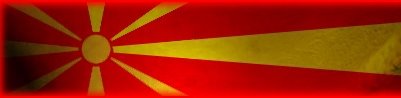
Good for the Macedonians in Albania.
Balkanalysis.com Rapid Reactions: Rights of Macedonians in Albania Finally Addressed with New Political Party:
The tables haven't exactly turned, but only 4 years after the Albanians in Macedonia started a war allegedly for 'human rights,' the small Macedonian minority in Albania, centered around the area of Lakes Ohrid and Prespa, has finally won the right to form a political party. MIA reports:
'...The first Macedonian party has been registered Wednesday in Albania named - 'Macedonian Alliance for European Integration.'
Eftim Mitrevski, President of the Macedonian community in Albania, in the interview with Macedonian Television said that the registration in the Tirana Court passed without any problems. 'The court had finally made a positive decision,' he said.
The first steps of the party, as Mitrevski said, were organizational strengthening in all three areas where Macedonians in Albania live - Golo Brdo, Gora and Prespa.
He said that the first party of Macedonians will provide a positive contribution to successful resolution of problems encountered by Macedonians in Albania, and it will also encourage the democratic processes in the country.'
The Greeks have long used the apparent presence of a 'Greek minority' in Albania as a trump card to counterbalance Albanian claims of injustices against their own citizens living in Greece. Macedonia has never been able to do the same, in part because their power of persuasion and international influence are pitiful compared to the Hellenes, and partly because their minority in Albania is smaller (5,000 according to the authorities, up to 350,000 according to the Macedonians) and pacifistic in comparison to the approximately 700,000 Albanians living in Macedonia.
In general, however, Albania has been much more charitable towards its Macedonian minority than has Greece. The Florina-based group Rainbow continues to push for the Macedonian cause in Greece,which continues to ban the return of most of the 'Begaltsi,' Macedonians expelled from Greek Macedonia during the bloody civil war of 1945-48.
For a comprehensive account of this conflict, we recommend Andre Gerolymatos' Red Acropolis, Black Terror: The Greek Civil War and the Origins of Soviet-American Rivalry, 1943-1949. We will be reviewing this book later in the summer, and would like to remind readers that by buying your books via the Amazon links and search boxes on the site you are not only enjoying fascinating books, you are also directly contributing to the survival of Balkanalysis.com in a difficult time for independent media.
Here is a list of other books we have reviewed that will be of interest.
posted by Balkanalysis Blog Editor @ 6/9/2005 11:37:00 AM"
Thursday, June 09, 2005


Wednesday, June 08, 2005
Again, Mountain Men With Guns
This incident seems to be a program to paralyze the Macedonian government. We will have to see if the American Ambassador allow the Macedonian police to take action.
RADIO FREE EUROPE/ RADIO LIBERTY: "ANOTHER ARMED INCIDENT OUTSIDE MACEDONIAN CAPITAL
A group of armed men held a four-member police patrol for several hours in the village of Kondovo outside the Macedonia capital Skopje on 5 June, dpa reported. Despite sporadic gunfire, nobody was wounded in the incident. The armed group was reportedly led by Agim Krasniqi, who admitted that he provoked the incident, the private A1 TV reported on 7 June. At the same time, Krasniqi refused to surrender to the authorities, saying he would not get a fair trial. The Interior Ministry declined to comment on the case. Krasniqi's group in effect occupied Kondovo in late 2004 for several weeks before it agreed to disarm following talks with the leaders of the two main ethnic Albanian parties. The group allegedly sought to protest what it called the slow implementation of the 2001 Ohrid peace agreement (see 'RFE/RL Newsline,' 15 and 20 December 2004, and 'RFE/RL Balkan Report,' 10 December 2004 and 14 January 2005). UB"
RADIO FREE EUROPE/ RADIO LIBERTY: "ANOTHER ARMED INCIDENT OUTSIDE MACEDONIAN CAPITAL
A group of armed men held a four-member police patrol for several hours in the village of Kondovo outside the Macedonia capital Skopje on 5 June, dpa reported. Despite sporadic gunfire, nobody was wounded in the incident. The armed group was reportedly led by Agim Krasniqi, who admitted that he provoked the incident, the private A1 TV reported on 7 June. At the same time, Krasniqi refused to surrender to the authorities, saying he would not get a fair trial. The Interior Ministry declined to comment on the case. Krasniqi's group in effect occupied Kondovo in late 2004 for several weeks before it agreed to disarm following talks with the leaders of the two main ethnic Albanian parties. The group allegedly sought to protest what it called the slow implementation of the 2001 Ohrid peace agreement (see 'RFE/RL Newsline,' 15 and 20 December 2004, and 'RFE/RL Balkan Report,' 10 December 2004 and 14 January 2005). UB"
If I Had a Hammer, I Hammer in the Morning ...
If anyone wants to know why the people of Europe are against the new EU constitution, even if the politicians are for it, they should read this article. Herr Schroeder says that Macedonians have to be nice children if they want to join the EU, while Greeks can piss on the books of their classmates, but still not be sent to the principals office. Where’s the outrage, where's the humanity, where’s the justice, where’s the F%@&ing bathroom!
Schroeder slams critics of EU Balkan enlargement
8 June 2005
BERLIN - German chancellor Gerhard Schroeder on Wednesday attacked "populists" for seeking to destroy the European Union with a bid to prevent the bloc's enlargement in the western Balkans.
Schroeder, at a news briefing with Macedonian prime minister Vlado Buckovski, said the example of Macedonian stability was closely linked to its prospects for membership in the European Union and Nato.
The chancellor warned that ending these perspectives would fuel instability and he accused EU sceptics of using the rejection of EU constitution by French and Dutch voters in a bid to wreck the entire Union.
"Instability is much more expensive," said Schroeder in reply to a reporter who
asked how enlargement into the region could be funded, adding: "You would be amazed if I told you how much the current situation in the Balkans with European soldiers costs."
Prime Minister Buckovski said being on track for closer EU and Nato ties was a crucial message of his government which helped counter extremists.
Schroeder, however, was wary about naming any concrete timetable for the admission of western Balkans nations to either the EU or Nato.
"This will vary greatly ... because the political and economic developments in the Balkans vary greatly," said Schroeder, adding: "I cannot tell you how long negotiations will take."
The chancellor praised Macedonia as being a frontrunner in the region, but he added that Buckovski's government needed to make more progress in privatisation and on domestic reforms.
Schroeder slams critics of EU Balkan enlargement
8 June 2005
BERLIN - German chancellor Gerhard Schroeder on Wednesday attacked "populists" for seeking to destroy the European Union with a bid to prevent the bloc's enlargement in the western Balkans.
Schroeder, at a news briefing with Macedonian prime minister Vlado Buckovski, said the example of Macedonian stability was closely linked to its prospects for membership in the European Union and Nato.
The chancellor warned that ending these perspectives would fuel instability and he accused EU sceptics of using the rejection of EU constitution by French and Dutch voters in a bid to wreck the entire Union.
"Instability is much more expensive," said Schroeder in reply to a reporter who
asked how enlargement into the region could be funded, adding: "You would be amazed if I told you how much the current situation in the Balkans with European soldiers costs."
Prime Minister Buckovski said being on track for closer EU and Nato ties was a crucial message of his government which helped counter extremists.
Schroeder, however, was wary about naming any concrete timetable for the admission of western Balkans nations to either the EU or Nato.
"This will vary greatly ... because the political and economic developments in the Balkans vary greatly," said Schroeder, adding: "I cannot tell you how long negotiations will take."
The chancellor praised Macedonia as being a frontrunner in the region, but he added that Buckovski's government needed to make more progress in privatisation and on domestic reforms.
US Hot on Kosovo Independence
I wonder if the Harvard and Yale men at the US State Department have any idea of the impact of an independent Kosovo will have on the Crimea, Abkhazia, Kurdistan, or Cyprus. I think they do and just want to shake the trees to see what falls down! The Guardian Newspaper used to be a leftist paper, now it is just a poodle, like Blair.
Guardian Unlimited | Special reports | US pushes for decision on Kosovo status: "US pushes for decision on Kosovo status
Jonathan Steele
Wednesday June 8, 2005
The Guardian
The US is stepping up the pace for a decision on whether Kosovo should have independence, and believes full-scale negotiations should start this autumn, according to Nicholas Burns, the state department's third-ranking official.
The UN, which runs the province as a protectorate, has just appointed a special envoy to decide whether the Albanian majority has done enough to protect Serbs and other minority groups in Kosovo. Although the envoy was asked to report this summer, Mr Burns jumped the gun on the eve of a visit to Kosovo today.
'It's the view of my government that sufficient progress has been made to start final status talks. Kosovo was put on the backburner for years. We have to go back and complete the job,' he said in London.
His remarks will not go down well in the Serbian capital, which Mr Burns, the US undersecretary of state for political affairs, will also visit.
The province is still formally part of Serbia but has been under UN rule since Nato intervened six years ago to drive out the Yugoslav army and Serb police and stop ethnic cleansing against Albanians. After Serb forces withdrew at least half the Serb population fled, and the rest now live in enclaves with little freedom of movement.
To try to make Albanian leaders promote fair law enforcement, human rights, and devolved local government, before talks on independence began, the UN adopted a policy of 'standards before status'. Mr Burns said the US no longer saw any value in delay. 'It's now standards and status,' he said.
His visit to the region, along with his firm comments, are widely seen as proof that the US has taken the lead again in forcing the pace in the Balkans. But the US official made clear he hoped the final status talks, which may last up to nine months, would be led by a European with an American deputy. Lord Ashdown, Bosnia's administrator, and the former Finnish president Martti Ahtisaari have been mentioned as candidates.
The US has been careful not to come out publicly in favour of any particular outcome for Kosovo - not even 'conditional independence', a formula favoured by international thinktanks whereby foreign troops and human rights monitors would stay on for years even though the territory would be sovereign.
The Serb government has proposed a status described as 'more than autonomy, less than independence', but has not given details. Western governments say there can be no return to Serb rule, as in 1998, nor can Belgrade have a veto.
Meanwhile, the former Kosovo prime minister Ramush Haradinaj, who resigned in March after being indicted by the Hague tribunal for crimes against humanity, allegedly before the 1999 war, has won bail to return to Pristina. "
Guardian Unlimited | Special reports | US pushes for decision on Kosovo status: "US pushes for decision on Kosovo status
Jonathan Steele
Wednesday June 8, 2005
The Guardian
The US is stepping up the pace for a decision on whether Kosovo should have independence, and believes full-scale negotiations should start this autumn, according to Nicholas Burns, the state department's third-ranking official.
The UN, which runs the province as a protectorate, has just appointed a special envoy to decide whether the Albanian majority has done enough to protect Serbs and other minority groups in Kosovo. Although the envoy was asked to report this summer, Mr Burns jumped the gun on the eve of a visit to Kosovo today.
'It's the view of my government that sufficient progress has been made to start final status talks. Kosovo was put on the backburner for years. We have to go back and complete the job,' he said in London.
His remarks will not go down well in the Serbian capital, which Mr Burns, the US undersecretary of state for political affairs, will also visit.
The province is still formally part of Serbia but has been under UN rule since Nato intervened six years ago to drive out the Yugoslav army and Serb police and stop ethnic cleansing against Albanians. After Serb forces withdrew at least half the Serb population fled, and the rest now live in enclaves with little freedom of movement.
To try to make Albanian leaders promote fair law enforcement, human rights, and devolved local government, before talks on independence began, the UN adopted a policy of 'standards before status'. Mr Burns said the US no longer saw any value in delay. 'It's now standards and status,' he said.
His visit to the region, along with his firm comments, are widely seen as proof that the US has taken the lead again in forcing the pace in the Balkans. But the US official made clear he hoped the final status talks, which may last up to nine months, would be led by a European with an American deputy. Lord Ashdown, Bosnia's administrator, and the former Finnish president Martti Ahtisaari have been mentioned as candidates.
The US has been careful not to come out publicly in favour of any particular outcome for Kosovo - not even 'conditional independence', a formula favoured by international thinktanks whereby foreign troops and human rights monitors would stay on for years even though the territory would be sovereign.
The Serb government has proposed a status described as 'more than autonomy, less than independence', but has not given details. Western governments say there can be no return to Serb rule, as in 1998, nor can Belgrade have a veto.
Meanwhile, the former Kosovo prime minister Ramush Haradinaj, who resigned in March after being indicted by the Hague tribunal for crimes against humanity, allegedly before the 1999 war, has won bail to return to Pristina. "
Tuesday, June 07, 2005
Too Many VMRO's
I think that the Macedonian government should ban the use of historical names for current political parties. Names to be banned include VMRO, Communist (any other recommendations) etc. No more VMRO-DPMNE, VMRO-VMRO, United VMRO etc. It annoys me when some leftist Macedonians criticize the right by saying “those damn “Vmrovtsi”. . These names belong to history and to all the Macedonian people.
Institute for War and Peace Reporting: "Macedonia: Nationalist Crisis Keeps Government Buoyant
Plagued by divisions, nationalists are far from offering a serious challenge to the ruling Social Democrats.
By Tamara Causidis and Zoran Fidanoski in Skopje (BCR No 558, 02-Jun-05)
Macedonia's right-wing opposition VMRO DPMNE went through another reshuffle last weekend, offering fresh signs of the turmoil that has been dogging the party and preventing it from challenging the ruling Social Democrats, SDSM.
The shake-up, targeting opponents of the party leader, Nikola Gruevski, was the third such personnel change since Gruevski took over in 2003.
At the same time, Gruevski said the party would merge with four smaller offshoots that emerged over the past few years as result of splits in VMRO DPMNE.
'Despite the divisions we have seen until now, we are now uniting, which shows VMRO DPMNE will win the upcoming parliamentary elections,' Gruevski announced confidently on May 31.
Analysts warn that such victory talk is premature. Moves to absorb smaller parties may be a healthy sign, they say, but the old standard-bearer of the nationalist right remains divided and locked into an outdated agenda.
'Since Macedonia's independence the opposition has never been weaker,' lamented Dosta Dimovska, a founder of VMRO DPMNE and former partyvice-president. 'That enables SDSM to continue as the main political factor in the country.'
The parties Gruevski referred to are marginal groups. Set up mainly byformer VMRO DPMNE members that were sacked or left, they all kept theVMRO prefix in their names. None has won enough votes to enter parliament.
Analysts see Gruevski's latest move as an attempt to overcome the crisis shaking VMRO DPMNE and show it can again become the biggest opposition party."
Institute for War and Peace Reporting: "Macedonia: Nationalist Crisis Keeps Government Buoyant
Plagued by divisions, nationalists are far from offering a serious challenge to the ruling Social Democrats.
By Tamara Causidis and Zoran Fidanoski in Skopje (BCR No 558, 02-Jun-05)
Macedonia's right-wing opposition VMRO DPMNE went through another reshuffle last weekend, offering fresh signs of the turmoil that has been dogging the party and preventing it from challenging the ruling Social Democrats, SDSM.
The shake-up, targeting opponents of the party leader, Nikola Gruevski, was the third such personnel change since Gruevski took over in 2003.
At the same time, Gruevski said the party would merge with four smaller offshoots that emerged over the past few years as result of splits in VMRO DPMNE.
'Despite the divisions we have seen until now, we are now uniting, which shows VMRO DPMNE will win the upcoming parliamentary elections,' Gruevski announced confidently on May 31.
Analysts warn that such victory talk is premature. Moves to absorb smaller parties may be a healthy sign, they say, but the old standard-bearer of the nationalist right remains divided and locked into an outdated agenda.
'Since Macedonia's independence the opposition has never been weaker,' lamented Dosta Dimovska, a founder of VMRO DPMNE and former partyvice-president. 'That enables SDSM to continue as the main political factor in the country.'
The parties Gruevski referred to are marginal groups. Set up mainly byformer VMRO DPMNE members that were sacked or left, they all kept theVMRO prefix in their names. None has won enough votes to enter parliament.
Analysts see Gruevski's latest move as an attempt to overcome the crisis shaking VMRO DPMNE and show it can again become the biggest opposition party."
Serbs of Macedonia Caught in the Middle
It is very interesting that some Serbs have rejected the Serbophile Priest Jovan, but it does not discuss his support among other Serbs in Skopje and Kumanovo, not to mention his support among Macedonians … if any. I have yet to read a good article in English about Jovan and his supporters. If I can’t find it, then neither can the BBC or CNN.
Reality Macedonia : Veles: Serbs Dump Jovan: "Source: Dnevnik, June 3, 2005 (Direct link)
Veles: Serbs Dump Jovan
The Serbian community in Veles denounced the decisions of the Serbian Orthodox Church for recognition of the so-called Orthodox Ohrid Archbishipric of the defrocked episcope Jovan. Serbs from Veles claim that they remain in the Macedonian Orthodox Church and that they will attend its temples in regard to their religious needs.
'We thank Vranishkovski and his archbishopric for their wish to represent us, but we refuse their services. The decision to create a new church only managed to cause dissatisfaction among the local Serbs, because it endangered their good relations with their friends, relatives and neigbors,' stated Vlastimir Jovic, member of the Local board of the United Serbian Community from Veles.
Jovic reminded the public that members of the Board participated in banishing Zoran Vranishkovski from the Povardarska Eparchy of MPC."
Is the EU Still the Right Road for Macedonia
I think that the EU constitution was rejected because of the fear of having Turkey as a member. If Macedonia is tied to Turkish membership, then we will never get in. Time for Macedonia to make contingency plans. Russia is calling.
FT.com / Home UK - Don't turn your backs on us, leaders of the former Yugoslavia plead with Brussels: "Don't turn your backs on us, leaders of the former Yugoslavia plead with Brussels
By Eric Jansson
Published: June 3 2005 03:00 | Last updated: June 3 2005 03:00
Balkan leaders yesterday urged the European Union to confirm its commitment to enlarging into the former Yugoslavia, after resounding No votes in France and the Netherlands cast doubt on the EU's future enlargement.
A June 16-17 meeting of European heads of government in Brussels could provide an opportunity for the EU to reinforce its Thessaloniki declaration of 2003, when leaders from all EU member states promised that 'the future of the Balkans is within the European Union'.
But with the EU leaders focused on the upheaval caused by No votes in this week's referendums on the European constitution, Balkan leaders could be disappointed.
Radmila Sekerinska, Macedonia's deputy prime minister, said in the capital Skopje: 'Enlargement is not something that should be stopped, having in mind the Thessaloniki summit, where the member states decided to proceed with the 'open door policy' and gave clear tasks for Europe to go forward with broadening the EU.'"
FT.com / Home UK - Don't turn your backs on us, leaders of the former Yugoslavia plead with Brussels: "Don't turn your backs on us, leaders of the former Yugoslavia plead with Brussels
By Eric Jansson
Published: June 3 2005 03:00 | Last updated: June 3 2005 03:00
Balkan leaders yesterday urged the European Union to confirm its commitment to enlarging into the former Yugoslavia, after resounding No votes in France and the Netherlands cast doubt on the EU's future enlargement.
A June 16-17 meeting of European heads of government in Brussels could provide an opportunity for the EU to reinforce its Thessaloniki declaration of 2003, when leaders from all EU member states promised that 'the future of the Balkans is within the European Union'.
But with the EU leaders focused on the upheaval caused by No votes in this week's referendums on the European constitution, Balkan leaders could be disappointed.
Radmila Sekerinska, Macedonia's deputy prime minister, said in the capital Skopje: 'Enlargement is not something that should be stopped, having in mind the Thessaloniki summit, where the member states decided to proceed with the 'open door policy' and gave clear tasks for Europe to go forward with broadening the EU.'"
Don't let UMINK Play With Matches
I don't know anything about Soren Jessen-Petersen, but he is playing with fire. Why can't he wait for final talks between Kosovo and Serbia. Why is creating anxiety where none should exist. This is a manufactured issue ... I smell a plot!
RFE/RL Newsline, 05-06-06: "[41] UNMIK HEAD SAYS KOSOVAR-MACEDONIAN BORDER DEMARCATION TO BEGIN BEFORE STATUS TALKS
Soren Jessen-Petersen, who heads the UN civilian administration in Kosova (UNMIK), said after a meeting with Macedonian Prime Minister Vlado Buckovski in Skopje on 2 June that the demarcation of the border between Kosova and Macedonia will begin before the future status of the province is decided, the private A1 TV reported. Buckovski said talks between Macedonia, UNMIK, and the elected Kosovar authorities on technical issues will start on 9 June (see 'RFE/RL Newsline,' 13, 16, and 17 May 2005). However, Enver Sopjani -- an adviser to Kosovar Prime Minister Bajram Kosumi -- said the Kosovar government has yet to decide whether it wants the border to be demarcated before or after the talks on the future status of the province, adding that the demarcation cannot be decided without the consent of the Kosovar authorities. UB"
RFE/RL Newsline, 05-06-06: "[41] UNMIK HEAD SAYS KOSOVAR-MACEDONIAN BORDER DEMARCATION TO BEGIN BEFORE STATUS TALKS
Soren Jessen-Petersen, who heads the UN civilian administration in Kosova (UNMIK), said after a meeting with Macedonian Prime Minister Vlado Buckovski in Skopje on 2 June that the demarcation of the border between Kosova and Macedonia will begin before the future status of the province is decided, the private A1 TV reported. Buckovski said talks between Macedonia, UNMIK, and the elected Kosovar authorities on technical issues will start on 9 June (see 'RFE/RL Newsline,' 13, 16, and 17 May 2005). However, Enver Sopjani -- an adviser to Kosovar Prime Minister Bajram Kosumi -- said the Kosovar government has yet to decide whether it wants the border to be demarcated before or after the talks on the future status of the province, adding that the demarcation cannot be decided without the consent of the Kosovar authorities. UB"
Macedonia - Conquered - Not Divided
I don't remember the particulars, but it seems to me that someone from the Macedonian Academy produced a map with exchange of territories between Macedonia and Albania.. I don't have any proof, but I doubt that this academic produced this report on his own without consulting Georgievski. Exchange of territory is not the problem, the terms under which it is concluded it the issue.
balkanalysis.com - Georgievski: Xhaferi and I Had No Deal to Divide Macedonia
n response to sensational new testimony from former coalition partner Arben Xhaferi, Ljubco Georgievski denied the long-suspected conspiracy theory that states he and the DPA leader had plotted the 2001 war as a controlled conflict preliminary to dividing the country according to ethnicity. However, his answer is sufficiently vague as to leave unanswered the question of whether they had at least hoped for such a result.
Speaking in an interview for Kosovo media, Xhaferi alleged that ever since the VMRO-DPA coalition came to power in 1998, the plan for dividing the country along ethnic lines was being considered. According to him, an amicable divorce could have saved a lot of headaches: “…we could have avoided the possibility for violence. We could have separated in a peaceful way. The war stopped us.”
balkanalysis.com - Georgievski: Xhaferi and I Had No Deal to Divide Macedonia
n response to sensational new testimony from former coalition partner Arben Xhaferi, Ljubco Georgievski denied the long-suspected conspiracy theory that states he and the DPA leader had plotted the 2001 war as a controlled conflict preliminary to dividing the country according to ethnicity. However, his answer is sufficiently vague as to leave unanswered the question of whether they had at least hoped for such a result.
Speaking in an interview for Kosovo media, Xhaferi alleged that ever since the VMRO-DPA coalition came to power in 1998, the plan for dividing the country along ethnic lines was being considered. According to him, an amicable divorce could have saved a lot of headaches: “…we could have avoided the possibility for violence. We could have separated in a peaceful way. The war stopped us.”
According to A1, Xhaferi also said that on the partition idea they even consulted functionaries from Belgrade such as the assassinated Prime Minister Zoran Djindjic, who agreed with this idea and also promoted the division of Kosovo.
However, the former prime minister fired back in a letter to the Macedonian media (he is currently out of the country, says A1), that the allegations are untrue. “…I didn’t have any conversation at all with Mr. Xhaferi about this idea until the beginning of the [2001] war,” claimed Georgievski. “Then, Xhaferi didn’t want to talk about this problem and the conversation finished.”
In this context, A1 reminds of the initiative by the Macedonian Academy of Arts & Sciences to make a territorial and population exchange in the middle of the 2001 conflict. Georgievski, then prime minister, had long been criticized for not condemning this proposal. It was the negative public reaction, however, that prevented Georgievski from promoting it actively.
What could be Xhaferi’s motive? The wily old politician who was during the war beloved by the West has become increasingly alienated from the internationals since the ascension to the throne of former Swiss mental patient Ali Ahmeti. The DPA, trounced during the March local elections, has seen its status imperiled at the national and now municipal levels. Many believe that Xhaferi was gravely disappointed at being supplanted by Ali Ahmeti as spokesman for the Albanian people. Since then, he seems to have lost the political will to make a meaningful challenge to Ahmeti’s DUI. As such, the DPA platform has become dependably nationalistic, criticizing throughout the DUI for allegedly slow and incomplete implementation of the Ohrid Agreement
Since his exit from power, Georgievski too has been relegated to the sidelines but still managed to convey his views on partition in newspaper columns. His breakaway party, VMRO-Narodna, was also shut out at the polls in March. The failure of their nationalistic politics in the elections indicated that they were, more or less, flogging a dead horse. On the other hand, neither Xhaferi nor Georgievski have anywhere to go but up. They have nothing to lose, no responsibilities to the people, and thus have room to experiment.
However, the key factor – demography – dictates that with every passing year, the bargaining power of the Macedonian side becomes weaker and weaker. This partly explains how the SDSM’s “compromises” with DUI over the Ohrid “reforms” have been so ridiculously one-sided. The latter knew, as did the Rolling Stones, that ‘time, time, time is on our side.’
A new report from the Institute for Strategic Investigations in the Macedonian Academy of Arts & Sciences, drawing on the 2002 census results and other data, states that the “ethnic balance” will be ruined by a high Albanian birth rate and the Macedonians’ aging population – in a nutshell, the exact problem EU countries now face with their own Muslim minorities.Daily newspaper Dnevnik quotes Professor Elka Dimitrieva from the Institute for Economy, who claims that between the 1994 and 2002 censuses, “great quantitative differences” have occurred, which will have far-reaching results in the future.
“…The total population has a minimum increase of 3.9 percent,” Elkova says. “But for the Macedonians is registered an increase from 0.2 percent, and for the Albanians, 22.7 percent. Albanians are responsible for 89 percent of the total increase of the population.”
However, in the same article academic and former prime minister Nikola Klusev pointed out that “…the increase of Albanians has been made greater with migrations from Kosovo and South Serbia. In the census of 2002, instead of being a regular, statistical operation, it acquired political dimensions. That’s why we had irregular things – boycotts, writing [on the census form] for the people who are not in the country, and writing more than once for the same person. That makes a big difficulty for demographic analysis.”
There is no reason to believe that Ahmeti and his comrades were ever interested in a multi-ethnic Macedonia, much less a unitary one. But compared to today’s DPA, they seem practically angelic. Nevertheless, the current farce of the decentralization and other apparent “compromises” merely represent the temporary simulation of good faith. In a decade or so, when the Framework Agreement will have done its work and its planners and Western backers are retired or dead, the demographic and linguistic disparity will have become unavoidable. By this time too Western governments (and especially the US) fatigued by the fallout of expensive wars in the Middle East and beyond will take a different view.
By that time, the think-tanks and experts who from 2001 until now have been shrieking about how Macedonia could not be divided because my God, what would that imply about all of us as humans will hypocritically come to look at partition as not only a relief but as a sensible result – because by that time the geographical area dominated by Albanians will be large enough that the remaining chunk of Macedonian land will not be large enough to survive as an independent entity. It will become a question of efficiency, since after all Kosovo at its current size cannot survive either. At present, Macedonia remains just a little too large to be digested by its neighbors.
Of course, if the trends illustrated by the French and Dutch referendums are any indicators, by that time the EU and its self-appointed moral lawgivers may have a lot more to worry about than any amount of bloodshed or woe that could be caused by anything that happens in Macedonia and the Balkans.
Yes! Macedonia # 2, Greece # 3
If Macedonians had a "Rapid Response" team, we could respond to this report from the US. Ironic as it may seem, The US does produce some good reports on human rights around the world. The US State Department's report on Human Rights is better than "Freedom House, International Crisis Group, IWPR (International War and Peace Reporting.
CNN.com - U.S. lists levels�of human�trafficking - Jun 3, 2005
14px;">WASHINGTON (AP) -- The placement of countries in the State Department's annual report on trafficking in persons.
CNN.com - U.S. lists levels�of human�trafficking - Jun 3, 2005
14px;">WASHINGTON (AP) -- The placement of countries in the State Department's annual report on trafficking in persons.
TIER ONE: Countries whose governments fully comply with U.S. minimum standards:
Australia, Austria, Belgium, Canada, Colombia, Czech Republic, Denmark, France, Germany, Hong Kong, Italy, Lithuania, Luxembourg, Morocco, Nepal, Netherlands, New Zealand, Norway, Poland, Portugal, South Korea, Spain, Sweden, United Kingdom.
TIER TWO: Countries whose governments do not fully comply with the minimum standards, but are making significant efforts to bring themselves into compliance with those standards:
Afghanistan, Albania, Algeria, Angola, Argentina, Bangladesh, Belarus, Bosnia-Herzegovina, Brazil, Bulgaria, Burkina Faso, Burundi, Chad, Chile, Democratic Republic of Congo, Costa Rica, Croatia, Cyprus, East Timor, Egypt, El Salvador, Equatorial Guinea, Estonia, Ethiopia, Finland, Gabon, Georgia, Ghana, Guatemala, Guyana, Honduras, Hungary, Indonesia, Iran, Israel, Ivory Coast, Japan, Kazakhstan, Kenya, Kyrgyz Republic, Laos, Latvia, Lebanon, Libya, Macedonia, Madagascar, Malawi, Malaysia, Mali, Mauritania, Moldova, Mongolia, Mozambique, Nigeria, Oman, Pakistan, Panama, Paraguay, Peru, Romania, Senegal, Serbia-Montenegro, Singapore, Slovenia, Sri Lanka, Switzerland, Syria, Taiwan, Tajikistan, Tanzania, Thailand, Turkey, Uganda, Uruguay, Vietnam, Yemen, Zambia.
TIER TWO SPECIAL WATCH LIST: Countries whose governments do not fully comply with the minimum standards, but are making significant efforts to bring themselves into compliance and meet one of the following conditions:
a) The absolute number of victims of severe forms of trafficking is very significant or is significantly increasing.
b) There is a failure to provide evidence of increasing efforts to combat severe forms of trafficking in persons from the previous year
c) The determination that a country is making significant efforts to bring themselves into compliance with minimum standards was based on commitments by the country to take additional future steps over the next year.
Armenia, Azerbaijan, Bahrain, Belize, Benin, Cameroon, China, Dominican Republic, Gambia, Greece, Guinea, Haiti, India, Mauritius, Mexico, Nicaragua, Niger, Philippines, Russia, Rwanda, Sierra Leone, Slovak Republic, South Africa, Suriname, Ukraine, Uzbekistan, Zimbabwe.
TIER THREE: Countries whose governments do not fully comply with the minimum standards and are not making significant efforts to do so:
Bolivia, Cambodia, Cuba, Ecuador, Jamaica, Kuwait, Myanmar, North Korea, Qatar, Saudi Arabia, Sudan, Togo, United Arab Emirates, Venezuela.
Subscribe to:
Posts (Atom)