The Macedonian Tendency: Tourism
Showing posts with label Tourism. Show all posts

Sunday, September 04, 2011

Mountain Climbing in Macedonia

the 3rd time is a charm « Fox Tales From Macedonia Blog:
August 24th, 2011 § 3 Comments


Or was it 4 ?  
Last weekend was momentous, mountainous … I have tried a few times to do a day hike to Tumba peak on the Belasica Mountian range (http://en.wikipedia.org/wiki/Belasica) where Macedonia, Greece and Bulgaria meet.
A big thank you to the Strumica Hiking club that organized the two day hike. They hauled our (75 people?) tents, sleeping bags and extra stuff up on a tractor. We hiked the 1st half of the trail in a few hours then had the evening to eat, drink, relax and meet new friends. In the morning we rose early for breakfast and the remainder of the hike up to the top to celebrate, turn around and make our way down to the bottom stopping mid way for lunch and pack up our things. They provided the 3 meals as well as having a medical person on hand “just in case”.
This experience is one of my favorite Macedonian experiences. Wonderful people and beautiful scenery. We listened to traditional music, danced and sang, picked wild berries (raspberries, black raspberries, blue berries), tried different home made rakjas, ate fresh made sheep cheese – right there on the mountain so close to the peak and made s’mores for the locals.
The s’mores were a hit (thanks to Austin), they don’t exist here. Marshmallows, if you can find them are a specialty item, very expensive and packaged differently. Graham crackers also do not exist here, they have cracker/biscuits that are close and would actually be really great on a s’more. They do have Hershey’s  chocolate bars. Most were afraid to try, the bravest were eyed suspiciously, waiting for the poisoning to take effect. Yes, some thought we were trying to poison them. My favorite … 2 old guys each with a s’more in their hands, one eating one watching. Eyeing his own s’more and his buddies half eaten one,  after much encouragement, he took a bite. He ended up eating at least two and then helped us make them by handing us the marshmallows to roast and stacking chocolate between the graham crackers for us to make and pass around, with sticky marshmallow cream stuck to his huge grin and whiskery chin. When the chocolate and graham crackers were gone we just roasted the marshmallows and passed the sticks around for people to pull off and eat the toasted sticky treat.
I could do this again. It was well worth the exhaustion and aching feet and legs. There are so many more stories I could tell, just enjoy the pictures. Thank you Eli, Austin, Christine and Robert. Thank you, Macedonia.


Saturday, September 03, 2011

"Macedonia Loves You”

"Macedonia Loves You” :: EMGplus:


02. September 2011. | 11:01


The project "Macedonia Loves You" began in 2007 and promotes the beauty of Macedonia, friendship and understanding among the people since then. In 2010 the project "Macedonia Loves You" started other project "The Best Promoter of Macedonia" which ended with great success.
The project "Macedonia Loves You" has started the third edition of the websitewww.macedonialovesyou.com aimed at joining the celebration of the 20th anniversary of independence of the Republic of Macedonia.

New edition focuses on promoting the idea Macedonia@20 and presenting the beauties of Macedonia through twenty words or twenty images. Macedonians and foreigners describe the country from their personal aspect.
The Professor of Chicago University described the Macedonian language in twenty words, while honorary consul in Belgium said that there are many adjectives than can be replaced with one word: Macedonian.
The Macedonians narrate about their biblical country, steeped in history...like a pearl hidden in its shell.

Macedonia@20 is a campaign open to all who like to share their impressions and reflections on beauties of Macedonia in 20 words or 20 images.

The project "Macedonia Loves You" began in 2007 and promotes the beauty of Macedonia, friendship and understanding among the people since then. In 2010 the project "Macedonia Loves You" started other project "The Best Promoter of Macedonia" which ended with great success. It second edition will begin on Sept. 14, 2011.

It's In The Little Things... Skopje, Macedonia - As We Travel - Travel Videos & Travel Blog

It's In The Little Things... Skopje, Macedonia - As We Travel - Travel Videos & Travel Blog:


Since our planning was so rushed, we decided to skip the beautiful lake Ohrid and stay in the capital – apparently, the capital city isn’t known to be a great hot spot for tourists …
”The most popular thing to do in Skopje is to leave” - people said on the internet.
Although I have to admit it was a funny answer to my question of things to do in Skopje, like many times before, other people’s thoughts of a place wouldn’t keep me from going there.
Arriving in Skopje I kind of realize what they were talking about. The train station looked so run down that we wondered if it was closing down, and the tourism information center was nowhere to be seen.
People kept pointing in opposite directions leading to nowhere, and we soon realised that there was no such thing as a tourist information center in Skopje, and no real maps of the city either…
And with a video episode to film, we were wondering how it would turn out.
The main attraction in Skopje for example, the castle, had suddenly closed without any warning.
The tour groups coming in buses all the way from other places like Ohrid, only to see this castle, were rudely informed in the gates that it was closed due to ”politics”, and disappointed they had to go back to their buses and return home.
But once we got to the city center, it turned out not to be too difficult to fill the day.
Skopje was actually a really nice place, and most people seemed so happy to see the very few tourists that were strolling the streets.
”Skopje GOOD!” a man yelled at us on the street and smiled proudly.
”Welcome to Skopje!” someone else said on a market, and asked us to take a photo of him, while the neighboring stall keepers laughed without being able to hide their excitement.
Being one of the few tourists there we had many people staring at us, and when asking for directions in a bar the worker would actually drop everything, come with us outside and lead us through the whole city to show us his favorite cafe.
This is what I love about smaller places, often in places like this people take more time for each other and treat you with a lot more respect.
It’s all in the little things…

Friday, September 02, 2011

Macedonia - Holiday Hotspot - Telegraph

Once strife riven countries that have become holiday hotspots - Telegraph:

"Macedonia:"


Summary: The people of Macedonia were on the receiving end of oppression from the Greeks in particular and earlier from the Turks, Bulgarians and Serbians. They constantly fought for their independence since and civil rights but until 1944 were denied their right to exist as an independent state. Despite having been proclaimed an independent state in 1944, however, as late as 1995, Greece was still refusing to recognise the existence of Macedonia or accept its right to use the name ‘Macedonia’ for the country, nation and language. This was because of Greece’s fears that Macedonia would lay cultural claim over Aegean Macedonia.
Holiday Attractions:
The wide variety of churches and monasteries. The museums in Macedonia which display nearly 3000 years worth of history and ancient culture. The physical landscape of the country also makes it a popular destination, especially the lakes and small villages and mountainous countryside which make it popular with walkers and nature lovers. Other tourist attractions include the fortresses including Marko’s Fortress, Skopje’s Fortress and Samuel’s Fortress which are significant historical monuments and ‘reflect the architectural grandeur of contemporary periods’, according to mapsoftheworld.com.

Tuesday, February 22, 2011

15 Monastery Stays - Ohrid is # 10!

15 Monastery Stays Worldwide:
Kristin Conard


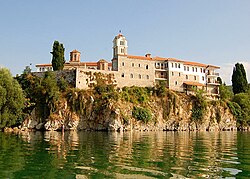
10. Sveti Naum, near Ohrid, Macedonia

I walked across the border between Albania and Macedonia near Lake Ohrid, and I could hear the mournful call of the peacocks that live at the 9th-century monastery before I finally reached it. Along with the peacocks, there is a hotel/spa on the grounds. It’s a peaceful place, and I was impressed at how well the architecture and feel of the hotel blended with the monastery."

Sveti Naum, Ohrid Macedonia

Friday, May 30, 2008

30 Great Site! Balkan Travellers

By David Edenden

There is a great deal to learn about Macedonia and the Balkans in this site! Christopher Deliso is one of the bloggers.


Balkan Travellers Tito, Teto and Some Troubled Tourism Await You in Tetovo, Macedonia ... When asked about Ohrid, people from other parts of Macedonia tell the following ...

Balkan Travellers - Serbia, Macedonia and Romania Join Europe in Various cities throughout the Balkans are joining the international Night of the Museums event, ...

Balkan Travellers - Macedonia Speeds up Archeological Excavations 2 May 2008 | Work on the archaeological excavations at Skupi, one of Macedonia’s most important sites, is to intensify next week, national media reported. ...

Balkan Travellers - Mother Teresa Philatelic Exhibition Opens in 10 March 2008 | An exhibition of postage stamps, seals and maps with the image of Mother Teresa that were issued in Macedonia, Albania, India, ...

Balkan Travellers - Culinary (and Other) Delights of Macedonia's In this engaging travel piece, the author recounts a summer expedition into Macedonia’s wine country, ...

Balkan Travellers - Exciting Year Ahead for Archeology in Macedonia 29 Jan 2008 Macedonia is set to develop a number of interesting archaeological projects in 2008, ...

Balkan Travellers - Clocks Reinstalled at Sultan Murat Mosque Clocks Reinstalled at Sultan Murat Mosque Tower in Macedonia’s Capital ... Use BalkanTravellers.com's tips to organize your trip to Macedonia

Balkan Travellers - Macedonia Begins Construction of Museum on The construction of the museum over the waters of the Ohrid Lake in Macedonia, one of the country’s ...

Balkan Travellers - Macedonia Icons to be Shown in Byzantine Art ...4 Apr 2008 ... A portal for travellers to and from the Balkans., Eight precious Macedonian icons will be part of the Byzantium 330-1453 show at the Royal ...

Balkan Travellers - Vinica Fortress in Macedonia to Become Tourist 7 Mar 2008 The Vinica Fortress in Macedonia will receive financial support for archaeological and ...

Balkan Travellers - Archaeologists from Kosovo and Macedonia to Archaeologists from Kosovo and Macedonia to rub shoulders at Tetovo fortress.

Balkan Travellers - Among Prilep's Thunder and Lightning Treskavec, Macedonia’s most inaccessible monastery, stands in the eye of the ... We realize that the monastery’s name [in Macedonian, treskavec means a ...

Balkan Travellers - Macedonia’s Ajvar Proves a Hit in the USA portal for travellers to and from the Balkans., Ajvar proved to be one of the most sought after products at Macedonia’s stand of the Chicago Food and ...

Balkan Travellers - Skopje Film Festival Begins in Macedonia The eleventh edition of the Skopje Film Festival opens on Saturday with a screening of the widely ...

Balkan Travellers - Italians to Invest in a Winter Resort near The resort is situated only some 50 km from Macedonia’s capital, ... Like Macedonia’s entire territory, the Tetovo region is rich in historic and ...

Balkan Travellers - Macedonia Bids to Become Major Tennis Destination Macedonia announced it will invest 5 million euro in the building of some 100 tennis courts all across the ...
Balkan Travellers - The Macedonian Town of Ohrid, Where Time StoppedA portal for travellers to and from the Balkans., The Macedonian Town of Ohrid, Where Time Stopped.

Balkan Travellers - Ethno-Jazz: Vlatko Stefanovski Still, if you want to hear a more refined version of local folklore, one of the names to look out for is that of the Macedonian guitar-player Vlatko ...

Balkan Travellers - White Tower, Bloody Tower After Macedonia split off from Yugoslavia in 1991, the Greeks accused it of having expansionist intentions, due to the depiction of the White Tower in the ...


Tuesday, December 18, 2007

Bulgarians About Travel in Tetovo, Macedonia

Tito, Teto and Some Troubled Tourism Await You in Tetovo
Balkan Travellers


Text by Dimana Trankova | Photographs by Anthony Georgieff

Legend says that Tetovo was named after the mythical Teto, who cleared snakes from what was a village at the foot of the Å ar Mountain many centuries ago. But perhaps this fable alone won't persuade you to leave the Skopje to Ohrid highway and visit this city in northwest Macedonia close to the border with Kosovo. Indeed, Tetovo has hardly been a magnet for travellers. For a long time the only tourists near here were those en route to Macedonia's most famous ski resort, Popova Å apka.

Unfortunately, to most outsiders, Tetovo is not renowned for its skiing facilities. Rather, it has a more forbidding reputation. It is the scene of the Albanian separatist National Liberation Army's (NLA) fierce clashes with Macedonian security forces in the 2001 conflict.

But the Albanian minority's unofficial capital, at one time part of the Ottoman Empire, as well as belonging to Serbia, Great Albania and Yugoslavia – and also the refuge for a considerable number of tsarist officers after the Russian Revolution – offers a pleasant and friendly surprise.

Tetovo's central square is not exactly enticing. It has the usual combination of broken pavements and dilapidated monuments, relics of the Communist era under Marshal Tito, the former Yugoslavian leader who tried to steer his own path between East and West.


Tito's buildings are of an architectural style designed to prove the superiority of his brand of Communism over Todor Zhivkov's. Just don't expect any earth-shattering contrast to Bulgaria!

But don't give up on Tetovo just yet. Turn left into Ilindenska Street and reach the humpback stone bridge over the Pena River. There you will see, rising on the other side of the river, a building that can rightfully claim to be the world's most colourful mosque. And the interior is just as striking as its façade.


The walls of the Aladzha Mosque, also known as Å arena Dzamija, or the “Painted” Mosque, are covered with geometrical shapes in green, blue, ochre and red – a truly delightful sight. And, thankfully, the building forms just part of a brighter enclave in an otherwise drab location.

Surrounding the mosque is a small park with well-maintained rosebushes and towering trees that provide a welcome contrast to the neglected central square. The Pena River babbles at its side and an abandoned Turkish bath cuts across it, part of an old complex of inns around the mosque.


Until fairly recently it housed a restaurant that went by the rather pretentious name of “Sheraton”. The octagonal turbe, or tomb, with the remains of Hurshida and Mensure, the women who founded the complex (the first building was finished in 1459), is right in front of the mosque.

“Do you like it? They used 30,000 eggs to make the paint.” A friendly young schoolgirl from the building's top-floor religious school approached us inside the mosque to practise her English. But most children are shy and only speak Albanian, the second official tongue in the Macedonian Republic since 2002.

The addition of the second language stemmed from provisions in the peace treaty that ended the conflict. Under its terms any language spoken by more than 20 percent of the population became, like Macedonian, an official state language. The Albanians, numbering just over 25 percent, are the only group eligible. But tolerance of another tongue has failed to dissolve simmering tensions. Since the republic split from Yugoslavia after a 1991 referendum, relations between Tetovo's two largest ethnic groups have been precariously poised between peace and war.

The South East European University was part of the problem. Established illegally in several houses in the nearby village of Mala Rechica, it became the country's first institution to teach students in Albanian. Legalised in 2001, it now has its own web page and is a rival to Tetovo State University.


But the Bektashi monks in the nearby Harabati Baba Tekke, a Dervish lodge, have a long history of hardship. Situated outside the city, by the large new cemetery at the foot of Popova Å apka, the monastery has a conspicuous three-storey, ultramarine-painted tower. The monks claim the tower was the last home of a high-ranking Albanian named Roxalana, who died of tuberculosis there. According to a more popular theory, it was part of the monastery's defence system, founded in the 16th Century.

The tower could not protect the tekke either from being burnt by guerrillas in 1948 or from Yugoslavia's Communists, who banned its religious activities and converted it from a haven of meditation into a tourist complex comprising a hotel, restaurant and disco. In those years – ironically, the Macedonian Communist Party was founded in 1943 in Tetovo – the monastery was silent proof of the legend explaining its unofficial name, Sersem Tekke, or the Fool's Tekke.

The story, recounted by present-day Bektashi monks with suitable self-irony, relates to a dream of Ali Baba, one of Suleiman the Magnificent's most esteemed high officials. The vision of this highly respected Bektashi leader in the Ottoman Empire was so inspiring that Ali Baba decided to abandon secular life and devote himself to religious contemplation. Angered but powerless, Suleiman told his vizier: “If you will be a sersem (fool), then go.” Ali Baba settled in Tetovo, which was practically unknown at the time, and became popular as Sersem Baba. Officially, the monastery is named after Harabati Baba, the only disciple of the former vizier, who took over the institution after Ali Baba's death in 1569.


While strolling in the large monastery garden or looking at the old stones in its cemetery, you may decide that Ali Baba was a sensible man rather than a sersem. The complex, whose main buildings were constructed in the 18th Century, became the focal point for the Bektashi living in this part of the Balkan Peninsula and survived even though Atatürk banned the order in its native Turkey in 1922. According to some estimates, nearly a quarter of Muslims here belonged to this denomination at the beginning of the 20th Century.

Despite Communist persecution, the tekke quickly restored its initial activities in 1995 following an initiative by Baba Tahir Emini. Today, there are 10 to 15 Bektashi monks living there. “We just want peace and privacy. So we don't advertise ourselves and we try not to attract tourists,” one of them tells us. But sit with them under the shed – decorated with portraits of Imam Ali, the reverse clocks and pictures from Baba Tahir Emini's funeral some months ago – and the monks can be very hospitable.

Gradually, more tourists are coming. Ironically, they're attracted not by the fêted Popova Šapka, or Priest's Hat, named after an Orthodox monk's headgear, but by the religious order and its monuments that were forbidden until just a few years ago.

This article is courtesy of the Bulgarian magazine Vagabond.

Saturday, December 08, 2007

BBC - Radio 4 - Excess Baggage

BBC - Radio 4 - Excess Baggage:


MACEDONIA
Christopher Deliso is an American travel writer, and a resident of Skopje, the capital of Macedonia. Its ruler, Alexander the Great, once conquered a large part of the known world, but for centuries since then Macedonia has been invaded and threatened by its neighbours; is it now finally emerging with its distinct national identity intact and, considering its hidden and unspoilt delights, will tourism be its saviour?


Presented by Sandi Toksvig

Greek Antique theatre by Lake Ohrid in Macedonia


Photo: Greek Antique theatre by Lake Ohrid in Macedonia (photographer: Wojtek Przybylski ©)

Monday, December 03, 2007

Meet Deliso in London, on Tuesday, 4th December!

News - The Travel Bookshop: London England

Hidden Macedonia Launch

Hidden Macedonia: The Mystic Lakes of Ohrid and Prespa by Christopher Deliso is to be launched at the Travel Bookshop on Tuesday, 4th December at 6.00pm


The lakes of Ohrid and Prespa are among the most ancient and enthralling in the world, abundant in rare wildlife and the seat of mediaeval kingdoms, richly endowed with sacred shrines, mysteries and watery legends. In this fascinating account of a circular summertime journey tracing the lakeshore through three countries, Greece, Albania and the Republic of Macedonia, the author seeks out the spirit of the lakes through encounters with its warm and welcoming people.

Penetrating the surface of everyday life and also revealing the deep historical wounds and controversies that still manifest themselves in this long-coveted land, this travelogue brings a colourful and complex history
vividly to life and offers an evocative and lighthearted chronicle of travels in one of the most stunning and historically significant areas
in Europe - one that remains, however, still largely to be discovered. In this splendid book, Christopher Deliso takes the reader on a rare visit to two of the world's unsung natural wonders and celebrates the spirit and hospitality of one of Europe's most engaging but least discussed peoples.Christopher Deliso is an American travel writer and journalist based in Skopje, Macedonia, who has been exploring and living in the Balkans and Mediterranean Europe for almost a decade. He has published numerous travel articles in newspapers, magazines and web sites around the world and also writes for Lonely Planet on the Balkans and Greece. He also directs the Balkan-interest online magazine www.balkanalysis.com. He holds an MPhil with Honours in Byzantine Studies from Oxford University.

Chris Deliso will take part on BBC Radio 4's 'Excess Baggage ' with Sandi Toksvig on SATURDAY 8 DECEMBER (10 - 10.30am).

Thursday, November 22, 2007

New Macedonia Travel Book

Hidden Macedonia
Amazon.com:
by Christopher Deliso

Editorial Reviews From Amazon
Product Description

The tectonic lakes of Macedonia, Ohrid and Prespa, are among he most ancient and enthralling in the world, abundant in rare wildlife and the seat of mediaeval kingdoms, richly endowed with sacred shrines, mysteries and watery legends. In this unprecedented account of a circular summertime journey tracing the lakeshore through three countries, Greece, Albania and the Republic of Macedonia, the author seeks out the spirit of the lakes through encounters with fishermen, philosophers, archaeologists and snakes. Penetrating the surface of everyday life and also revealing the deep historical wounds and controversies that still manifest in this long-coveted land, this heartfelt travelogue is also an evocative and at times riotously funny chronicle of travels in one of the most stunning and historically significant areas in Europe- one that remains, however, still largely to be discovered.


About the Author
Christopher Deliso is an American travel writer and journalist based in Skopje, Macedonia, who has been exploring and living in the Balkans and Mediterranean Europe for almost a decade. He has published numerous travel articles in newspapers, magazines and web sites around the world and also writes for Lonely Planet on the Balkans and Greece. He also directs the Balkan-interest online magazine. He holds an MPhil with Honours in Byzantine Studies from Oxford University.

Christopher Deliso

5 of 5 people found the following review helpful:
5.0 out of 5 stars A Splendid Little Journey, August 6, 2007
By Jason B. Miko (Tucson, AZ USA) - See all my reviews
(REAL NAME)
While many vacationers are jetting off to the likes of London, Paris or the Caribbean, Chris Deliso opens the window on a small, relatively undiscovered part of Europe, and reveals a delightful region of beauty, charm, culture, history and warmth. The lake region of Macedonia, which includes the enchanting lakes of Ohrid and Prespa, is made available to us through this brief travelogue in which Deliso travels with both companions and his family, stopping in little out-of-the-way villages and hamlets in Greece, Albania and Macedonia. Written in an easy, almost laidback style, Deliso throws in archeology, history, art, flora, fauna, geography, gastronomy, culture and a host of other subjects as he takes his readers on bumpy roads and across the placid lakes, spending time with the hospitable and warm folks who live there. Before you're halfway through the book, you might find yourself booking a trip to Macedonia to discover for yourself a unique and unspoiled part of Europe still unknown to most Westerners.

5.0 out of 5 stars A Hidden Jewel, August 28, 2007
By Sonja B (Sydney, Australia) - See all my reviews
It was such a pleasant surprise to discover that someone was bold enough to write about the ineffable beauty and spirit that is Macedonia, and particularly its lakes - and succeed in it. As soon as I received my copy of Deliso's Hidden Macedonia, I wasted no time getting into it, and found that I couldn't stop reading it until I finished it. Poetic, vivid, anecdotal and factual - truly a book I recommend to anyone who dares risk or cares to know or is curious, inclined for whatever reason, to ponder (and wonder) over a bit of land in Europe deeply steeped in history, and so naturally almost forgotten - hidden - but for Deliso's careful archaeological, historical eye for things mystical. Deliso's circular journey through three countries in the name of two lakes, Ohrid and Prespa, is one you won't forget. I'll go as far as saying that you should judge this book by its cover.

5.0 out of 5 stars Macedonia as a Metaphor, August 12, 2007
The author, Chris Deliso, has an MPhil with Honours in Byzantine Studies from Oxford University and his credentials shine throughout the book. His erudition, depth, narration skills, and exquisite (at times, painful) sensitivity to both human and nature give rise to a resonant, synoptic, panoramic, and thrilling travelogue. Chris, an American who made Macedonia his new home, and a family friend by the name of George, a Greek philosopher, are later joined by Chris's Macedonian wife, Buba, and their son, Marko. Together, they reify the Balkans: foreign influences, internecine rivalries, the resilience and warmth of its denizens, and the brighter future that hopefully awaits them all. Their lakes are the only things that the otherwise fractious Macedonia, Greece, and Albania share. The two and then the four tour the shores of these fabled bodies of water and get immersed in their history, archeology, politics, economy, and peoples. Edge-of-the seat situations lifted straight out of Expressionistic horror movies (the unforgettable foray to the Macedonian settlements on the Albanian side of Lake Prespa) alternate with sun and shimmering water and numerous heart-rending human interest stories as various cameo-protagonists struggle to maintain a modicum of human dignity in the face of the overwhelming odds of both gory history and destitution. Chris studies them all with subtlety and with a curious mix of scientific detachment and empathetic compassion. He is a genuine lover of humanity. His sometimes cynical observations are a mere defense mechanism against the pain and hopelessness that pervade this hitherto doomed region that he so clearly is enamoured with. Thus, Hidden Macedonia combines Dame Rebecca West's penetrating (but rarely merciless) insight with Robert Kaplan's narrative excellence. It joins this rarefied bookshelf as an equal. A must for anyone interested not only in the Balkans and in conflict and peace studies- but in what it is that makes us human and forms our personal identity. Sam Vaknin,


A Few Good Reasons to Visit in Old Bitola

A Cultured Café in Old Bitola
11/22/2007 (Balkanalysis.com)
By Christopher Deliso

Bitola, Macedonia’s lively southern second city, is bursting with cafés and bars, most centered around its central pedestrian thoroughfare, the Sirok Sokak, lined with neoclassical buildings and foreign flags hearkening back to Bitola’s heyday as the ‘city of consuls’ in the Ottoman Empire.

Today, however, most of the town’s cafés are more or less the same, modern and slick, trendy but with little spirit. Nevertheless, a few stand out, such as the three-year-old Café-Gallery Van, nestled in Bitola’s Old Bazaar. The inspiration of its owner, Vladimir Altiparmak, this cheerful place occupies the front room of a restored 200-year-old house, and is decorated with various artworks and photos, while classical music or jazz play softly in the background. The congenial Vladimir, who comes from one of the oldest Jewish families in Bitola, sought with his little café “to bring back the spirit and tradition of old Bitola that was destroyed in the old [Communist] system.”

cafevanbitolabalkanalysis2.jpg

Indeed, the Bitola that lingers in the imagination of Vladimir Altiparmak is that of the city before Communism took hold, and before World War II decimated the city’s traditional cultures. In 1943, Bitola’s Jewish community was all but destroyed when over 7,000 Macedonian Jews were deported to the Nazi death camps by the occupying Bulgarian army. At the time, Bitola was one of the cities in the southern Balkans with a notable Sephardic Jewish population; these people, descendents of Spanish Jews taken in by the Ottomans after the Inquisition in 1492, would play the major role in commerce and culture in not only Bitola, but Thessaloniki to the south, in today’s Greece. In the pre-war years, over 30 Ladino-language newspapers and magazines were published in Thessaloniki and read widely in Bitola, Stip, Skopje and other Macedonian towns.

Vladimir’s father, Boris, was educated in a French school in Thessaloniki in 1931. “I grew up under the old European cultural values of the time,” says Vladimir, adding that his father had guided the providential creation of Pelister National Park in the mountains above Bitola in 1948- the first such national park in Yugoslavia.

The building that now houses the Café-Gallery Van was in Vladimir’s family until the turbulence of World War II, after which it was claimed by the new Yugoslav state of Josip Broz Tito. After the end of Communism in 1991, and the independence of Macedonia, the Altiparmak family won back the 18th-century building in the denationalization process.

cafevanbitolaaltiparmakbalkanalysis.jpg

Vladimir Altiparmak seeks “to bring back the spirit and tradition of old Bitola” with his Café-Gallery Van.

However the building was in such a bad state that Vladimir had to really think about whether it was worth salvaging. After he decided to do so, he then had to think about what use he could make of it. In the end, his desire to help preserve the aesthetic of the Bitola of old led him to come up with the idea of creating a public space that would capture the spirit of the bygone city in both its architecture and exhibits.

When the determined renovator got down to work, however, he found that he was fighting not only a decrepit house, but also nature itself- oddly enough, when Vladimir went to cut through a wall, he found a thriving tree growing right up through the center of it. “The wall was pregnant,” he laughs. A photo now hangs on the wall nearby, attesting to the discovery.

Along with such photos of ten years worth of renovations, the café’s décor also includes very old family photos, paintings, church icons and other assorted displays set around an appealing interior of Byzantine brickwork, small bar and cozy tables, with a view of the shopping street of the old bazaar right outside. It’s a relaxing place, perfect for a mid-morning coffee and conversation, and is also used for occasional performances and events.

cafevanbitolabalkanalysis1.jpg


Visiting the café and speaking with Vladimir, whose family roots are from the Bitola and Krusevo areas of southern Macedonia, also brings up some unusual details from Macedonian history; his great-uncle, Teohar Neshkov, briefly became ‘minister of finance’ in the short-lived Krusevo Republic, the outcome of the 1903 revolt against the Ottomans. However, after less than two weeks Krusevo was overrun, the republic was destroyed, “and [Teohar] was cooked in an oven by the Turks,” laments Vladimir. The image of the dignified but ill-fated Teohar is captured in an old photo on display at the café.

For Vladimir, the little gallery-café represents the first of what he hopes will be many similar revitalization project in the old market area of Bitola, a neglected but still somewhat atmospheric place. “Most buildings in the Old Bazaar are still in bad condition because the state didn’t care about their upkeep,” he says. “But the neighborhood would not have value if the architecture is not preserved.”

However, it’s up to the owners of individual properties to make progress, as the city still does not have any plan for renovating with preservation of the old style in mind. And so, for now anyway, Café-Gallery Van stands out as the one place in the neighbourhood with a touch of singularity and culture. Nevertheless, the simple fact of its existence serves as an example of what the area, and Bitola as a whole, can aspire towards.

Details

Café-Gallery Van

+389 (0)47 223-890

Ulitsa Dalmatinska 29, Old Bazaar, Bitola

cafevanbitolabalkanalysis3.jpg

Thursday, July 12, 2007

Macedonia Gets the Times Seal of Approval


Make time for Macedonia -
Times Online:
The Times, London, January 28, 2006


Dramatic mountain and lake scenery, historic monastries and churches and great food. What's not to like, says Tony Kelly

Crowds poured into the arena, many of them ordinary Macedonians who had paid £35 for a ticket, the equivalent of a week’s wages. As the President finished his speech and took his seat, the audience hushed for the entry of the Spanish tenor José Carreras.

A performance from an internationally famous opera singer is not what you expect in the Balkans, but then Macedonia has a habit of defying expectations. In many ways, it is the forgotten country of the former Yugoslavia and the locals are hoping that events such as the Carreras concert will put their homeland on the map.

Most people would be hardpressed even to tell you where Macedonia is. Under Alexander the Great, it ruled an empire stretching from India to Egypt and Iraq, but these days its ambitions are rather more limited. After its peaceful break from Yugoslavia in 1991, it has been officially known as the Former Yugoslav Republic of Macedonia — a clumsy name designed to appease Greek sensibilities and distinguish it from the Greek province of Macedonia.

Until the 1990s, the country received half a million foreign visitors a year, but tourism dried up during the wars in Bosnia and Croatia and has yet to recover. This is a pity, since it means that people are missing out on magnificent mountains and lakes, historic monasteries and churches and some of the best food I have eaten anywhere.

The Spanish call a fruit salad a macedonia de frutas in a reference to the country’s ethnic mix, but the description could equally be applied to the cuisine. A typical Macedonian meal begins with a spread of mezes such as tarator (cucumber, garlic, yogurt and walnuts), pindzur (roasted aubergine and pepper relish) and sopska salata (cucumber, tomatoes and sheep’s cheese), accompanied by heaps of crusty white bread. Follow this with a grilled kebab or a mixed-meat casserole served in an earthenware pot, throw in a bottle of Skopsko beer or organic Macedonian wine, and you have the perfect lunch.

I have to admit that my first impressions were not that promising. The capital, Skopje, was razed by an earthquake in 1963 and the city centre is scarred by the concrete brutalism of 1960s communist town planners. One of the houses destroyed was Mother Teresa’s birthplace, now marked by a plaque at the entrance to a shopping mall. But as soon as I crossed the elegant stone-arched bridge over the river Vardar to enter the old town, I found myself in a labyrinthine souk of mosques, caravanserais and baths.

For 500 years, Macedonia was part of the Ottoman empire and the Turkish legacy is evident everywhere, from veiled women shopping for jewellery to skullcapped men answering the call to prayer from the Mustafa Pasha mosque. In the Bit Pazar, Skopje’s sprawling outdoor bazaar, stallholders sell olives, almonds, raisins, spices, melons, cigarettes, silk dresses, car parts, mobile phones and second-hand TVs. Wailing Arabic music drifts from cafes and barbers’ shops, and the scent of grilled meat and Turkish coffee hangs in the air.

During the warmer months, anyone who can afford to heads for the beach. Not the sea — the nearest coastlines are Albania and Montenegro — but the shores of Lake Ohrid, Macedonia’s summer capital. “All of Skopje’s high society moves down to Ohrid in summer,” one diplomat told me.

Ohrid is a strange mix of historic pilgrimage town and modern holiday resort. Europe’s first university was founded here by St Clement in the 9th century; it was the birthplace of the Cyrillic alphabet and remains one of the holiest sites of the Orthodox Church.

Chapels and monasteries line the lakeshore, none prettier or more spectacularly sited than the small 13th- century church of St John at Kaneo, on the cliffs overlooking the lake. But when you have had enough of churches and museums, have climbed to the 10th-century fortress and have visited the lovely Icon Gallery at the Church of the Holy Mother of God, it is time to chill out. I spent an enjoyable day here swimming in the lake, taking a boat trip across the water and dining on fresh Ohrid trout at a waterfront restaurant.

Tourism in Macedonia has a long way to go. Hotels in the main towns are comfortable but largely lacking in character. There are Roman remains which are not clearly signposted and ski slopes and hiking trails known only to locals. All this will change, but for now Macedonia is one of the least-known and least-visited countries in Europe — which in a strange way is all part of its appeal.

Top tips
# Best Western Hotel Turist, Skopje (00 389 2328 9111) is a convenient choice in the centre of town. Double rooms are £85.

Friday, June 22, 2007

Crvenkovski to Meet Aussie Students

Cool School: Reservoir District Secondary College | Herald Sun:

"THOUSANDS of secondary school students trek overseas each year to broaden their minds and enhance their language studies. But Reservoir District Secondary College students must be the first to get a presidential welcome.
Eighteen students are touring the new Republic of Macedonia and central Balkans this month and will meet President Branco Crvenkovski and Prime Minister Nikola Gruevski.

Year 11 student Zoran Mitrevski, 16, says he was shocked when he heard about the special treatment.

“You wouldn't come to Australia and get a welcome like that,” he says.

Principal Robin Lockington says the meeting with the president was made possible through the school's close ties with the local Macedonian community and Embassy.

“From what we've been told, this is the first organised school trip to the new Republic of Macedonian,” Lockington says.

He says the year 9-12 students, who all study Macedonian, will get the chance to understand another culture and see how other people work and operate.

“These students will operate in a very different vocational world to what we have,” Lockington says.

“Australia is now part of the international community. By visiting other countries, it broadens their horizons about what's involved.

Saturday, March 24, 2007

Video Macedonia

Great site for videos from Macedonia focusing on tourism and culture.

Video postcard from Macedonia
Video Macedonia:

This video clip shows scenes from Republic of Macedonia, some of the last really untouched nature on the European continent."

Friday, March 16, 2007

This is Serious, Not Fishy!

Ohrid and this fish are a great asset for future tourism when Macedonia gets its act together. Save the 'Ohrid trout" now!

Diners eating 'ancient' Macedonian trout into extinction
OHRID, Macedonia (AFP)

Praised by chefs around the world and devoured by many a celebrity, the rare trout of Lake Ohrid still graces menus in many Macedonian restaurants, despite being on the edge of extinction.

What's on your wish list?

The 'Ohrid trout,' or Salmo letnica by its scientific name, was identified as unique in 1924, but locals prefer to brand it as 'ancient' since its closest species is only found in fossils.

Its moniker comes from the only body of water in which it is found -- Lake Ohrid, one of the oldest in the world along with Baikal in southeast Russia and Tanganyika in eastern Africa."

Friday, March 02, 2007

Macedonia ranks 83rd in Travel & Tourism Competitiveness Index

I don't know who said it, but one Macedonian was quoted as saying "pity the county for whom Albania is the "WEST". Anyway, we can brag that we are 7 points ahead of Albania

Makfax vesnik:

"As regards the countries in the region, Greece was ranked 24th, Croatia 38th, Hungary 40th, Slovenia 44th, Turkey, 52nd, Bulgaria 54th, Serbia and Montenegro 61st, Romania 76th, Albania 90th, Bosnia and Herzegovina 104th."

Thursday, March 01, 2007

"Olympic's of Tourism" for Macedonia

One of the ways for Macedonia to increase tourism from the diaspora, is for the Macedonian tourist authorities to designate village reunions every four years, like the Olympics. In this way Macedonian emigrants can plan their vacations years in advance and get to meet their relatives, all at the same time. Each week can be designated for 5 or so villages and since there are 8 weeks in the summer that gives us 40 village reunions. It should be possible to go through all the villages in "historical Macedonia" in 4 or 5 years before repeating the process. (Remember Skopje and Bitola are not villages, no one comes from there. They are always from somewhere else.) I am talking about ancestral villages.

For example, the first week of July, 2010 could be proclaimed "Bouf Reunion Week" [The village of Bouf (Akrita) in Lerin (Florina)]. Dances and picnics can be scheduled, hotels reserved and famous Boufchani (if there are any) and be invited. Hear what Louie Dimitrovski has to say about Boufchani.

The guests coming for family reunions can be surveyed as to what business they are employed in and contacts can be arranged with local business people. Doctors and lawyers can meet with their local counterparts.I had thought that there could be a permanent "business trade show" created so that Macedonian business people can deduct their trip as a business expense ... an added bonus... but I am not sure how it would work. Macedonians could also invite their friends to an exotic, but safe, tourist destination

I have been told that, in addition to having relatives in Macedonia and Greece, I also have relatives in Bulgaria, Serbia, the US, Australia, France, and Belgium. Meeting in Macedonia at "Village Reunion Week", scheduled years in advance is the only way that we will ever meet.

The "village reunion movement" could act as a foundation for a "reconciliation movement" of Macedonians who have been split between Grkoman, Srboman, Bugaroman, Macedonianists and between pro-communist (Tito) and anti-communist (Tito) factions. I especially think it would be valuable for Macedonians living in Greece who are still afraid to reveal their identity for fear of reprisals and the Macedonians living in Bulgaria, who do not understand the "Macedonianism" of the Republic of Macedonia to meet their relatives in the Republic.

This effort, if marketed properly to western governments, could be funded by the US or EU.